Lofexidine
LUCEMYRA
What it isCentral alpha-2 agonist; opioid withdrawal symptoms.
Why this oneIt is the only non-opioid agent approved for withdrawal, so it can be used where buprenorphine cannot.
What limits itHypotension, bradycardia and QT prolongation. It treats symptoms only and does nothing for craving or relapse.
FDA-approved for
- opioid withdrawal (2018)
FDA label
Read the full label on DailyMed ↗
| FDA dosing | Population | Start | Target | Max |
|---|---|---|---|---|
| Mitigation of opioid withdrawal symptoms | Adults | 0.54 mg (three 0.18 mg tablets) QID, 5–6 hr apart | guided by symptoms | 0.72 mg/dose; 2.88 mg/day; up to 14 days |
Renal eGFR 30–89.9: 0.36 mg (2 tabs) QID; <30 / ESRD / dialysis: 0.18 mg (1 tab) QID
Hepatic Mild: 0.54 mg (3 tabs) QID; moderate: 0.36 mg (2 tabs) QID; severe: 0.18 mg (1 tab) QID
Single dose ≤0.72 mg; total ≤2.88 mg/day; treat up to 14 days
Instructions
- Taper over 2–4 days to discontinue (reduce 1 tab/dose every 1–2 days)
- May take with or without food
- Reduce, hold, or discontinue for excessive sedation, hypotension, or bradycardia
Cautions
- Hypotension, bradycardia, syncope
- QT prolongation (avoid in congenital long QT)
- CNS depression with concomitant CNS depressants
- Increased opioid overdose risk after opioid discontinuation
- Discontinuation symptoms incl. rebound hypertension
Adverse reactions
- Orthostatic hypotension
- Bradycardia
- Hypotension
- Dizziness
- Somnolence
- Sedation
- Dry mouth
- Insomnia
Pregnancy Safety not established; animal harm (resorptions, litter loss, stillbirths) at exposures below human
Lactation No human data; exercise caution in nursing women
NO BOXED WARNINGS
Principal riskHypotension and QT prolongation; it does nothing for craving
Cost, est. cash$300–$2,500/month
Generic entry2032 est.
Classes and tags
Clinical profile
Legacy pregnancy categoryNot assigned — PLLR-era drug
Defining liabilityGenerally tolerated at therapeutic doses; clinically important risks are agent-specific and increase with interactions or organ impairment.
Mechanism of action: Lofexidine ballicule
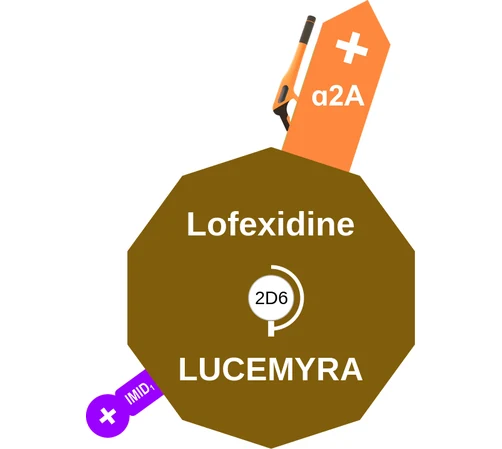
Open Lofexidine in the interactive console ↗
Memory aids: mascots and interaction avatars

orange plus signs → alpha-2 agonist