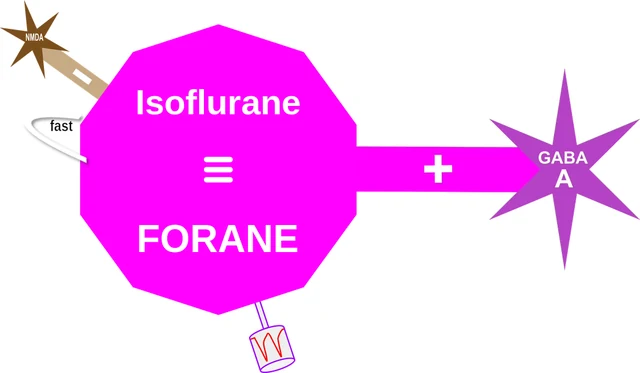
Isoflurane
FORANE
What it isVolatile GABA-A modulator, NMDA antagonist, and HCN-1 blocker; maintenance of anesthesia.
Why this oneLow cost and potent maintenance anesthesia keep it widely used where rapid emergence is less important.
What limits itPungency limits induction. It can trigger malignant hyperthermia and has substantial environmental persistence.
FDA-approved for
- inhalational anesthesia (1979)
FDA label
Read the full label on DailyMed ↗
| FDA dosing | Population | Start | Target | Max |
|---|---|---|---|---|
| Induction of general anesthesia | Adults | 1.5-3% inspired (surgical anesthesia in 7-10 min) | ||
| Maintenance of general anesthesia | Adults | 1-2.5% with N2O (add 0.5-1% with O2 alone) |
Renal Undefined
Hepatic Contraindicated after prior halogenated-anesthetic hepatitis/unexplained hepatic dysfunction; use with caution in hepatic disease
Instructions
- Administer only by personnel trained in general anesthesia, via a vaporizer designed for isoflurane
- Individualize and titrate to effect by age and clinical status (MAC decreases with increasing age)
- Replace desiccated CO2 absorbent before use to avoid carbon monoxide formation
- Have airway, ventilation, oxygen, and circulatory resuscitation immediately available
Contraindications
- Patients in whom general anesthesia is contraindicated
- Known or suspected genetic susceptibility to malignant hyperthermia
- History of confirmed hepatitis or unexplained moderate-severe hepatic dysfunction after a halogenated inhalational anesthetic
Cautions
- Malignant hyperthermia — discontinue triggers, give IV dantrolene, supportive care
- Perioperative hyperkalemia — especially neuromuscular disease/Duchenne muscular dystrophy
- Hepatic reactions/sensitivity hepatitis with repeated exposure
- Hypersensitivity reactions, incl. anaphylaxis
- QT prolongation/torsade de pointes — monitor susceptible patients
- Carbon monoxide from desiccated CO2 absorbents
- Pediatric neurotoxicity with >3 h exposure in children <3 yr
- Dose-dependent hypotension/reduced systemic vascular resistance
Adverse reactions
- Agitation
- Cough, breath holding
- Laryngospasm
- Nausea, vomiting
- Chills/shivering
- Delirium
- Arrhythmias
- Hypotension
Pregnancy No adequate human studies; animal embryofetal toxicity; prolonged 3rd-trimester/early-life exposure raises neurotoxicity concern.
Lactation Insufficient data on excretion in human milk; weigh risks and benefits before use in nursing women.
NO BOXED WARNINGS
Principal riskMalignant hyperthermia trigger; pungency limits induction
Classes and tags
Clinical profile
Mechanism of action: Isoflurane ballicule