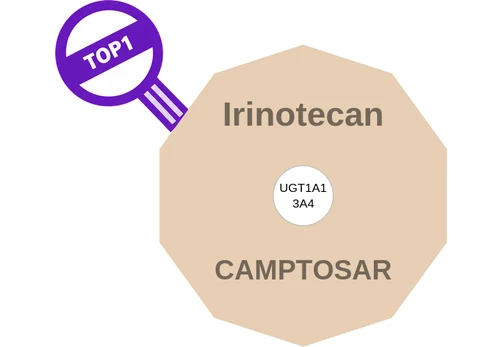
Irinotecan
CAMPTOSAR
What it isTopoisomerase I inhibitor; colorectal and pancreatic cancer.
Why this oneIt has activity in colorectal cancer after fluoropyrimidine failure.
What limits it⚑ Early cholinergic diarrhea responds to atropine; delayed secretory diarrhea needs aggressive loperamide. UGT1A1*28 raises toxicity.
FDA label
Read the full label on DailyMed ↗
| FDA dosing | Population | Start | Target | Max |
|---|---|---|---|---|
| Metastatic colorectal carcinoma — combination regimen 1 (with bolus 5-FU/LV) | Adults | IV 125 mg/m2 over 90 min days 1,8,15,22 (+ LV 20 mg/m2, 5-FU 500 mg/m2 bolus), 6-week cycle | Continue cycles indefinitely while benefiting; reduce per toxicity (dose levels 100, 75 mg/m2) | 125 mg/m2/dose |
| Metastatic colorectal carcinoma — combination regimen 2 (with infusional 5-FU/LV) | Adults | IV 180 mg/m2 over 90 min days 1,15,29 (+ LV 200 mg/m2, 5-FU bolus 400 + 22-h infusion 600 mg/m2), 6-week cycle | Continue while benefiting; reduce per toxicity (150, 120 mg/m2) | 180 mg/m2/dose |
| Metastatic colorectal carcinoma — single agent, weekly | Adults | IV 125 mg/m2 over 90 min days 1,8,15,22, then 2-week rest | Adjust 50-150 mg/m2 by tolerance | 150 mg/m2/dose (if no toxicity) |
| Metastatic colorectal carcinoma — single agent, every 3 weeks | Adults (age >=70: start 300 mg/m2) | IV 350 mg/m2 over 90 min q3wk | Adjust down to 200 mg/m2 by tolerance | 350 mg/m2 q3wk |
Titration Weekly single-agent only: if no toxicity, may increase by 25 mg/m2 at start of next cycle up to 150 mg/m2
Renal Not evaluated — use caution in renal impairment; not recommended in patients on dialysis
Hepatic Use caution — clearance reduced and active metabolite SN-38 increased proportional to impairment; no dosing recommendation possible for bilirubin >2 mg/dL; consider 1-dose-level starting reduction for increased bilirubin; bilirubin 1-2 mg/dL (weekly regimen) carries higher grade 3-4 neutropenia risk
Do not use with the 4-5 consecutive-day 5-FU/LV regimen outside a clinical study
Instructions
- Premedicate with antiemetics (e.g., dexamethasone 10 mg + 5-HT3 antagonist) >=30 min before infusion; consider atropine 0.25-1 mg IV/SC prophylactically or for cholinergic symptoms
- Dilute in D5W (preferred) or NS to 0.12-2.8 mg/mL; infuse over 90 min; use ASAP (<=24 h at 2-8 C); single-use vial
- Do not begin a new cycle until granulocytes >=1500/mm3, platelets >=100,000/mm3, and treatment-related diarrhea fully resolved; delay 1-2 weeks for recovery; consider discontinuing if not recovered after 2-week delay
- Consider 1-dose-level starting reduction for prior pelvic/abdominal radiotherapy, performance status 2, or increased bilirubin
- UGT1A1*28/*28, *6/*6, or *6/*28 genotypes: reduce starting dose by at least one level
- Extensive dose-modification tables by toxicity grade (neutropenia, neutropenic fever, diarrhea, other) — see label
- Hazardous drug — special handling; avoid extravasation (flush with sterile water, apply ice if it occurs)
Cautions
- Early (cholinergic) and late diarrhea — late diarrhea can be life-threatening; treat with loperamide, replace fluids/electrolytes, antibiotics for ileus/fever/severe neutropenia
- Myelosuppression — interrupt and reduce dose; deaths from sepsis after severe neutropenia reported
- Reduced UGT1A1 activity (*28/*28, *6/*6, *6/*28) — increased risk of severe neutropenia
- Hypersensitivity including severe anaphylactic/anaphylactoid reactions — discontinue
- Renal impairment/acute renal failure — usually with volume depletion from vomiting/diarrhea
- Interstitial pulmonary disease-like events, including fatal — interrupt for new/progressive dyspnea, cough, fever; discontinue if confirmed
- Embryo-fetal toxicity — effective contraception (females 6 months, males/condoms 3 months after last dose)
- Patients >=65: greater risk of early and late diarrhea — monitor closely; >=70 on q3wk regimen: start 300 mg/m2
Adverse reactions
- Combination (>=30%): nausea, vomiting, abdominal pain, diarrhea, constipation, anorexia, mucositis, neutropenia, leukopenia, anemia, thrombocytopenia, asthenia, pain, fever, infection, abnormal bilirubin, alopecia
- Single agent (>=30%): nausea, vomiting, abdominal pain, diarrhea, constipation, anorexia, neutropenia, leukopenia, anemia, asthenia, fever, weight loss, alopecia
Pregnancy Can cause fetal harm (embryofetal mortality and teratogenicity in animals below clinical exposure); verify pregnancy status; effective contraception during treatment and 6 months after (females); condoms during and 3 months after (males)
Lactation Irinotecan and metabolites present in human milk — do not breastfeed during treatment and for 7 days after final dose
⚠ BOXED WARNINGS
- Severe diarrhea
- Severe myelosuppression
Classes and tags
Clinical profile
Mechanism of action: Irinotecan ballicule