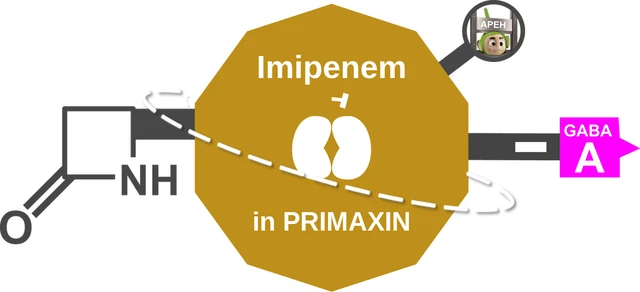
Imipenem
in PRIMAXIN
What it isCarbapenem given with cilastatin; severe and resistant infection.
Why this oneBroad cover including Pseudomonas and enterococci, with the widest spectrum of the carbapenems.
What limits itThe highest seizure risk of the carbapenems, so meropenem is preferred in meningitis. Cilastatin is required to block renal degradation.
FDA-approved for
- serious infections (1985)
FDA label
Read the full label on DailyMed ↗
| FDA dosing | Population | Start | Target | Max |
|---|---|---|---|---|
| Serious infections by susceptible bacteria: lower respiratory tract, UTI, intra-abdominal, gynecologic, bacterial septicemia, bone/joint, skin and skin structure, endocarditis | Adults, CLcr ≥90 mL/min | 500 mg IV q6h OR 1 g IV q8h (imipenem component) | 1 g IV q6h if pathogen of intermediate susceptibility | 4 g/day |
| Same, non-CNS infections | Peds ≥3 months | 15–25 mg/kg IV q6h | Per susceptibility | 4 g/day |
| Same, non-CNS infections | Peds ≤3 months, ≥1,500 g | 25 mg/kg IV: <1 wk q12h; 1–4 wk q8h; 4 wk–3 mo q6h | Per susceptibility | 4 g/day |
Renal CLcr <90 mL/min requires dose reduction (e.g. susceptible-pathogen regimen: CLcr 60–<90 → 400 mg q6h or 500 mg q6h; 30–<60 → 300 mg q6h or 500 mg q8h; 15–<30 → 200 mg q6h or 500 mg q12h; see label Table 3). CLcr <15: do not give unless hemodialysis is instituted within 48 h — dose after dialysis sessions. Seizure risk ↑ at CLcr ≤30. Peds <30 kg with renal impairment: not recommended (no data).
Hepatic Undefined
All doses expressed as the imipenem component; an equivalent amount of cilastatin is co-administered.
Instructions
- For intravenous infusion only: doses ≤500 mg over 20–30 min; doses >500 mg over 40–60 min; slow the infusion if nausea develops.
- Reconstitute vial and dilute in an appropriate infusion solution before administration.
- Do not use diluents containing benzyl alcohol for neonates.
- Not indicated in meningitis; not recommended in pediatric CNS infections (seizure risk).
Cautions
- Serious, occasionally fatal hypersensitivity (anaphylactic) reactions with beta-lactams; inquire about prior penicillin/cephalosporin/beta-lactam allergy; discontinue immediately if allergic reaction occurs.
- Seizures and CNS adverse reactions (confusional states, myoclonus) — most common with CNS disorders (brain lesions, seizure history) and/or renal impairment or when doses exceeded; continue anticonvulsants in known seizure disorders; if focal tremors/myoclonus/seizures occur, evaluate neurologically, start anticonvulsants, decrease or discontinue.
- Valproic acid/divalproex interaction — carbapenems reduce valproate levels below therapeutic range (breakthrough-seizure risk); concomitant use generally not recommended.
- Clostridioides difficile–associated diarrhea, mild to fatal colitis — evaluate if diarrhea occurs.
- Prescribing without proven/suspected bacterial infection risks drug-resistant bacteria.
Adverse reactions
- Adults (≥0.2%): phlebitis, nausea, diarrhea, vomiting, rash, injection-site pain, fever, hypotension, seizures, injection-site erythema, dizziness, pruritus, vein induration, urticaria, somnolence.
- Peds ≥3 months (>1%): diarrhea, rash, phlebitis, gastroenteritis, vomiting, IV-site irritation, urine discoloration.
- Neonates to 3 months (>1%): convulsions, diarrhea, oliguria/anuria, oral candidiasis, rash, tachycardia.
Pregnancy Insufficient human data. Animal studies (mice, rats, rabbits, monkeys, 0.4–2.9× RHD) showed no drug-induced fetal malformations; embryonic loss increased in cynomolgus monkeys at doses similar to the RHD.
Lactation Insufficient data on presence in human milk, effects on the breastfed child, or milk production; weigh benefits of breastfeeding against clinical need and potential adverse effects.
NO BOXED WARNINGS
Principal riskThe highest seizure risk of the carbapenems
Classes and tags
Clinical profile
Mechanism of action: Imipenem ballicule