DYAZIDE
Combination product
Pronunciation: hye-droe-klor-oe-THYE-a-zide and trye-AM-ter-een
Combination of Hydrochlorothiazide and Triamterene.
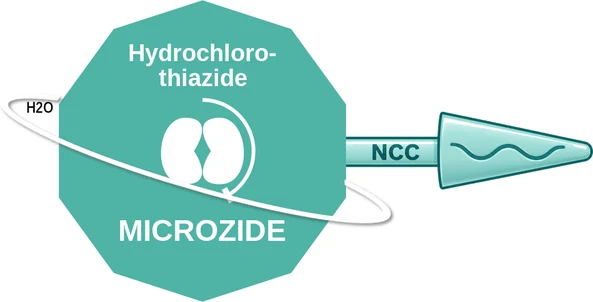
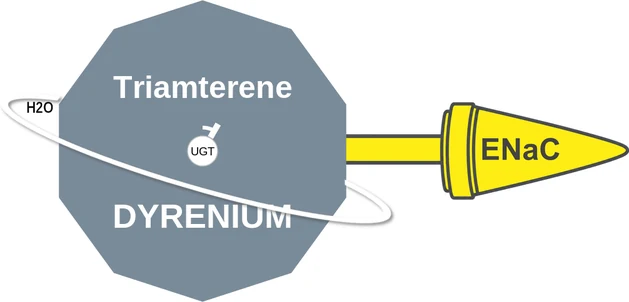
Each component keeps its own pharmacology page; the combination itself adds no new mechanism.
Components (2)
FDA label
Read the full label on DailyMed ↗
| FDA dosing | Population | Start | Target | Max |
|---|---|---|---|---|
| Hypertension or edema in patients who develop hypokalemia on HCTZ alone, or who need a thiazide and in whom hypokalemia cannot be risked | Adults | 37.5/25 mg: 1 tab QD (HCTZ 25 mg → 37.5/25; HCTZ 50 mg → 75/50 directly) | 37.5/25 mg 1–2 tabs QD (single dose) or 75/50 mg 1 tab QD | Two 37.5/25 mg tabs QD or one 75/50 mg tab QD (no experience above) |
Renal Contraindicated in anuria, acute/chronic renal insufficiency or significant renal impairment; mild impairment only with frequent electrolyte monitoring
Hepatic Caution in impaired hepatic function or progressive liver disease (may precipitate hepatic coma)
Not for initial therapy except when hypokalemia cannot be risked; avoid in diabetic patients
Instructions
- Give as a single daily dose with monitoring of serum potassium
- Avoid divided dosing (increased risk of electrolyte imbalance and renal dysfunction)
- When switching from less bioavailable formulations to 75/50 mg, monitor clinically and serum potassium
Available strengths
- tab 25/37.5, 50/75 mg
- cap 25/37.5 mg
Contraindications
- Hyperkalemia (serum potassium ≥5.5 mEq/liter)
- Other potassium-conserving agents (spironolactone, amiloride, other triamterene products) or potassium supplements/salt substitutes/potassium-enriched diets
- Anuria, acute or chronic renal insufficiency, or significant renal impairment
Cautions
- Hyperkalemia (may be fatal)
- Metabolic or respiratory acidosis
- Acute myopia and secondary angle-closure glaucoma
- Electrolyte imbalance and BUN increases
- Hepatic coma in liver disease
- Renal stones
- Folic acid deficiency
- Hyperuricemia/gout
- Metabolic/endocrine effects (calcium, glucose)
- Hypersensitivity; SLE exacerbation
- Non-melanoma skin cancer (HCTZ)
Adverse reactions
- Jaundice
- Nausea/vomiting
- Diarrhea
- Dizziness
- Headache
- Orthostatic hypotension
- Hyperkalemia/hypokalemia
- Hyponatremia
- Elevated BUN/creatinine
- Photosensitivity
- Rash
Pregnancy Safe use not established; use only if potential benefit justifies fetal risk (thiazides/triamterene cross placenta)
Lactation Thiazides excreted in human milk; triamterene in animal milk; if drug essential, stop nursing
Cost
Clinical profile
Defining liabilityHyperkalemia, electrolyte imbalance and renal dysfunction
Part D rank #164.
Self-check
- What problem on hydrochlorothiazide alone supports DYAZIDE’s listed use?
Hypokalemia with hypertension or edema. - Which potentially fatal electrolyte problem is boxed for DYAZIDE?
Hyperkalemia—potassium ≥5.5 mEq/L.