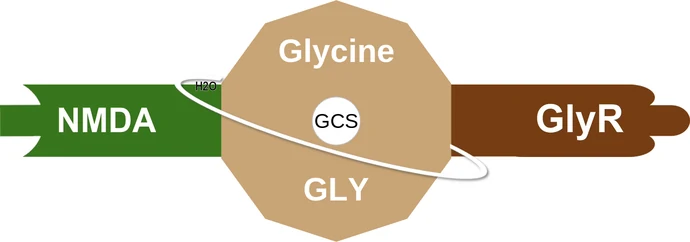
Glycine
GLY
What it isAgonist at inhibitory glycine receptors and co-agonist at the NMDA glycine site; used for urologic irrigation.
Why this oneIts opposing inhibitory-spinal and excitatory-NMDA roles make glycine-site pharmacology unusually context dependent.
What limits itSystemic absorption of irrigation fluid can cause dilutional hyponatremia, hyperammonemia, encephalopathy, and transient blindness.
FDA label
Read the full label on DailyMed ↗
| FDA dosing | Population | Start | Target | Max |
|---|---|---|---|---|
| Urologic irrigation during transurethral surgical procedures | Adults | 1.5% solution by transurethral instillation | Total volume solely at the surgeon's discretion | Not specified |
Renal Undefined
Hepatic Undefined
Container height above ~60 cm (2 ft) increases intravascular absorption of the irrigating fluid.
Instructions
- Administer only by transurethral instillation with appropriate urologic instrumentation.
- Use a disposable irrigation set.
- Not for injection by usual parenteral routes.
- Keep container height no more than ~60 cm (2 ft) above the operating table — greater height increases intravascular absorption of irrigant.
- Inspect visually for particulate matter and discoloration before use whenever the container permits.
- Additives may be incompatible — consult a pharmacist, use aseptic technique, mix thoroughly, and do not store.
Contraindications
- Anuria
- Not for injection by usual parenteral routes
Cautions
- Intravascular absorption of irrigant can cause fluid and electrolyte disturbance — hyponatremia (TUR syndrome), fluid overload, marked diuresis, edema, acidosis.
- Hyperammonemia with resulting coma and/or encephalopathy can follow glycine absorption.
- Cardiovascular and pulmonary consequences of absorption: hypotension, tachycardia, angina-like pain, pulmonary congestion.
- Discontinue the irrigant if any adverse reaction occurs, evaluate the patient, and save the remaining fluid for examination if needed.
Adverse reactions
- From intravascular absorption: salivation, nausea, lightheadedness.
- Fluid/electrolyte: acidosis, electrolyte loss, marked diuresis, urinary retention, edema, dry mouth, thirst, dehydration.
- Hyponatremia progressing to coma; secondary hyponatremia from fluid overload; hyperammonemia with coma/encephalopathy.
- Cardiovascular: hypotension, tachycardia, angina-like pain. Pulmonary: pulmonary congestion.
- Other: blurred vision, transient blindness, convulsions, vomiting, rhinitis, chills, vertigo, backache, urticaria. Allergic reactions to glycine are unknown or exceedingly rare.
Pregnancy Pregnancy Category C — animal reproduction studies not conducted; unknown whether it can cause fetal harm. Give to a pregnant woman only if clearly needed.
Lactation Undefined
NO BOXED WARNINGS
Principal riskAbsorbed irrigation fluid causes hyponatremia
Classes and tags
Clinical profile
Mechanism of action: Glycine ballicule