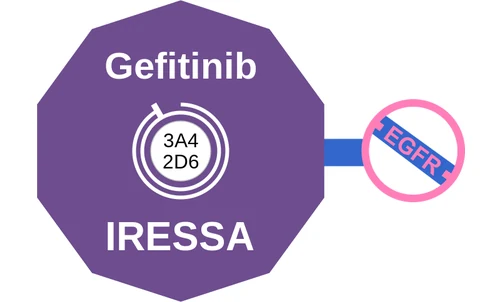
Gefitinib
IRESSA
What it isOral first-generation EGFR tyrosine kinase inhibitor that reversibly blocks ATP binding in the EGFR kinase domain.
Why this oneFirst-line therapy for metastatic non-small cell lung cancer harboring sensitizing EGFR mutations (exon 19 deletions or L858R).
What limits itCan cause interstitial lung disease (occasionally fatal) and hepatotoxicity, and its absorption falls sharply when gastric pH is raised by PPIs or H2 blockers.
FDA label
Read the full label on DailyMed ↗
| FDA dosing | Population | Start | Target | Max |
|---|---|---|---|---|
| Metastatic NSCLC, first-line, EGFR exon 19 deletion or exon 21 L858R mutation | Adults | 250 mg QD | Continue until disease progression or unacceptable toxicity | 250 mg QD (500 mg QD only with concomitant strong CYP3A4 inducer) |
Renal Undefined
Hepatic No baseline dose adjustment stated; monitor for adverse reactions in moderate-severe impairment (AUC +263%/+166%); discontinue for severe (treatment-emergent) hepatic impairment
Strong CYP3A4 inducer: increase to 500 mg QD (absent severe ADR); resume 250 mg QD 7 days after inducer discontinued
Instructions
- With or without food; do not take a missed dose within 12 h of the next dose
- Difficulty swallowing: disperse tablet in 4-8 oz water, stir ~15 min, drink immediately (or give via NG tube); rinse container with 4-8 oz water and drink
- Withhold up to 14 days for: acute/worsening pulmonary symptoms, Grade >=2 ALT/AST, Grade >=3 diarrhea, severe/worsening ocular disorders, Grade >=3 skin reactions; resume when resolved to <=Grade 1
- Permanently discontinue for: confirmed ILD, severe hepatic impairment, GI perforation, persistent ulcerative keratitis
Cautions
- Interstitial lung disease (1.3%, some fatal) - withhold for worsening respiratory symptoms; discontinue if ILD confirmed
- Hepatotoxicity (fatal 0.04%) - periodic LFTs
- GI perforation (0.1%) - discontinue
- Severe or persistent diarrhea
- Ocular disorders incl. keratitis - withhold for severe/worsening; discontinue for persistent ulcerative keratitis
- Bullous/exfoliative skin disorders incl. TEN, SJS, erythema multiforme
- Embryo-fetal toxicity - contraception during treatment and >=2 weeks after
Adverse reactions
- Skin reactions and diarrhea (>20%, > placebo)
Pregnancy Can cause fetal harm (mechanism + animal data: fetotoxicity/neonatal death below recommended human dose); advise risk
Lactation Discontinue breastfeeding during treatment (gefitinib 11-19x higher in rat milk than blood)
NO BOXED WARNINGS
Principal riskNo FDA boxed warning.
Cost, est. cash$50–$10,000/month or cycle
Generic entry2022
Classes and tags
Clinical profile
Legacy pregnancy categoryD
Defining liabilityMyelosuppression and agent-specific hepatic, cardiac, pulmonary, neurologic or reproductive toxicity require oncology monitoring.
Mechanism of action: Gefitinib ballicule