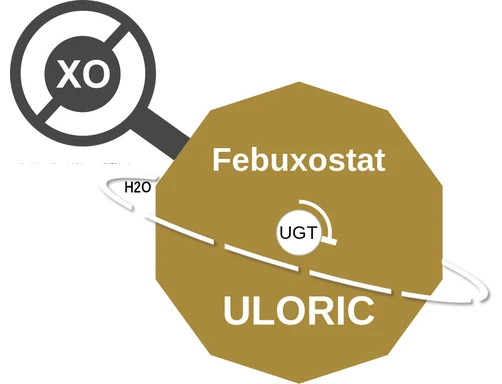
Febuxostat
ULORIC
What it isNon-purine xanthine oxidase inhibitor; chronic urate lowering in gout.
Why this oneIts non-purine structure makes it an option after allopurinol intolerance or hypersensitivity.
What limits itA cardiovascular-death signal keeps it second-line; xanthine oxidase inhibition can dangerously raise azathioprine or mercaptopurine.
FDA-approved for
- gout (2009)
FDA label
Read the full label on DailyMed ↗
| FDA dosing | Population | Start | Target | Max |
|---|---|---|---|---|
| Chronic gout (hyperuricemia) | Adults | 40 mg QD | 80 mg QD if sUA ≥6 mg/dL after 2 wk | 80 mg QD |
Titration Increase to 80 mg QD if serum uric acid ≥6 mg/dL after 2 weeks
Renal Mild–moderate: no adjustment; severe (CrCl 15–29): limit to 40 mg QD
Hepatic No adjustment for mild–moderate (Child-Pugh A/B); severe (C) not studied — use caution
Instructions
- Take without regard to food or antacid use
- Give flare prophylaxis with an NSAID or colchicine on initiation (beneficial up to 6 months)
- If a gout flare occurs, do not discontinue — manage the flare concurrently
Contraindications
- Concurrent azathioprine or mercaptopurine
Cautions
- Cardiovascular death — monitor for CV events; consider low-dose aspirin in CV disease
- Gout flares frequently increase after initiation
- Hepatic effects, including fatal hepatic failure — baseline and prompt LFTs; discontinue if liver injury confirmed
- Serious skin reactions (Stevens-Johnson syndrome, DRESS, toxic epidermal necrolysis) — discontinue if suspected
Adverse reactions
- Liver function abnormalities
- Nausea
- Arthralgia
- Rash
Pregnancy Limited data insufficient to inform risk; no adverse developmental effects in animal studies at exposures up to ~40–51x MRHD
Lactation No human data; present in rat milk
NO BOXED WARNINGS
Principal riskCardiovascular death signal versus allopurinol
Cost, est. cash$5–$150/month
Generic entry2019
Classes and tags
Clinical profile
Legacy pregnancy categoryC
Defining liabilityGenerally tolerated at therapeutic doses; clinically important risks are agent-specific and increase with interactions or organ impairment.
Mechanism of action: Febuxostat ballicule