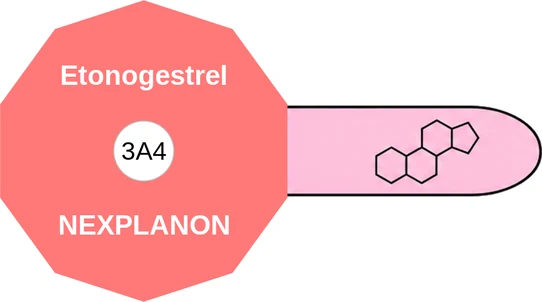
Etonogestrel
NEXPLANON
FDA label
Read the full label on DailyMed ↗
BOXED WARNING Risk of complications due to improper insertion and removal — proper training required before use; available only through a restricted REMS program (NEXPLANON REMS).
| FDA dosing | Population | Start | Target | Max |
|---|---|---|---|---|
| Contraception (prevention of pregnancy) | Women of reproductive potential (incl. postpubertal adolescents; not indicated before menarche or in women >65 y) | 1 implant inserted subdermally, inner side of non-dominant upper arm | Single implant provides contraception up to 5 years | 1 implant; remove by end of 5th year (may replace at removal) |
Renal Undefined
Hepatic Not studied; contraindicated in active liver disease or liver tumors
Efficacy does not depend on daily/weekly/monthly administration; insert by package expiration date
Instructions
- Rule out pregnancy before insertion
- Insertion/removal only by trained, REMS-certified healthcare professionals
- Insert subdermally just under the skin, inner side of non-dominant upper arm overlying triceps (8-10 cm from medial epicondyle, 3-5 cm posterior to biceps/triceps sulcus); avoid deep insertion
- Confirm implant is palpable immediately after insertion; if not palpable, localize — removal recommended
- No prior hormonal contraceptive: insert Days 1-5 of menstrual cycle
- Switching: from CHC — day after last active tablet/ring or patch removal; from injectable — day next injection due; from minipill — within 24 h of last tablet; from implant/IUS — same day as removal
- After 1st-trimester abortion/miscarriage: insert within 5 days; after 2nd-trimester: 21-28 days after
- Postpartum, not breastfeeding: insert 21-28 days postpartum; breastfeeding: not until after 4th postpartum week
- If insertion timing deviates from recommended, use barrier back-up method for 7 days after insertion
- Remove implant in its entirety no later than end of 5th year
Contraindications
- Known or suspected pregnancy
- Current or past history of thrombosis or thromboembolic disorders
- Liver tumors (benign or malignant) or active liver disease
- Undiagnosed abnormal uterine bleeding
- Known or suspected breast cancer, personal history of breast cancer, or other progestin-sensitive cancer (now or in the past)
Cautions
- Insertion/removal complications: pain, paresthesia, bleeding, hematoma, scarring, infection; deep insertion may cause neural/vascular injury or implant migration (incl. to pulmonary artery — chest pain, dyspnea, cough, hemoptysis); surgery may be needed for removal
- Non-palpable, broken, or bent implants: localize and remove in entirety; failure to remove may compromise fertility or cause ectopic pregnancy
- Changes in menstrual bleeding pattern (frequency, intensity, duration) — most common reason for discontinuation
- Ectopic pregnancy: be alert in users who become pregnant or report lower abdominal pain
- Thrombotic/vascular events (PE, DVT, MI, stroke reported): remove implant if thrombosis occurs; do not use before 21 days postpartum; consider removal with prolonged immobilization
- Remove if jaundice develops; remove if sustained/uncontrolled hypertension develops
- Ovarian cysts (enlarged follicles, usually resolve spontaneously)
- Monitor women with breast nodules or family history of breast cancer
- May induce mild insulin resistance — monitor prediabetic/diabetic women; may complicate hyperlipidemia control
- Weight gain; depressed mood — monitor women with history of depression
Adverse reactions
- Change in menstrual bleeding pattern (most common; leading cause of discontinuation, 11.1%)
- Headache (24.9%)
- Vaginitis (14.5%)
- Weight increase (13.7%)
- Acne (13.5%)
- Breast pain (12.8%)
- Abdominal pain (10.9%)
- Pharyngitis (10.5%)
- Emotional lability, depression, nervousness
- Implant site reactions (8.6%): erythema, hematoma, bruising, pain, swelling
- Insertion/removal complications incl. deep insertion, migration, difficult removal (postmarketing)
Pregnancy Contraindicated in pregnancy (no need for contraception if already pregnant); remove implant if maintaining a pregnancy; no increased risk of birth defects shown with low-dose hormonal exposure
Lactation Small amounts in human milk; no adverse effects observed in breastfed infants, but can reduce milk production; do not insert until after 4th postpartum week if breastfeeding; weigh benefits vs risk
NO BOXED WARNINGS
Classes and tags
Clinical profile
Mechanism of action: Etonogestrel ballicule