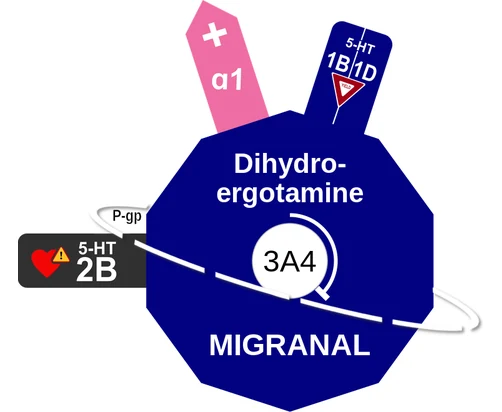
Dihydro ergotamine
MIGRANAL
What it isErgot agonist at 5-HT1B/1D and adrenergic receptors; refractory migraine and status migrainosus.
Why this oneIts prolonged action lowers recurrence and can still work late in an attack when triptans often do not.
What limits itCoronary or peripheral vasospasm can be catastrophic; avoid near triptans and with strong CYP3A4 inhibitors.
FDA-approved for
- migraine and cluster headache
Off-label
- status migrainosus and medication-overuse headache bridging
FDA label
Read the full label on DailyMed ↗
| FDA dosing | Population | Start | Target | Max |
|---|---|---|---|---|
| Acute treatment of migraine with or without aura | Adults | 5.2 mg (contents of one nasal device) into one nostril PRN | 5.2 mg PRN per attack | 10.4 mg/24 hr (two 5.2 mg doses) |
Renal Contraindicated in severe renal impairment.
Hepatic Contraindicated in severe hepatic impairment.
May repeat once, no sooner than 1 hr after the first dose; max 10.4 mg/24 hr. Safety of more than 4 doses in 7 days or 12 doses in 30 days has not been established.
Instructions
- Nasal administration only.
- Priming is not required.
- Remove the round blue tab from the blue nozzle and insert the nozzle into one nostril.
- Squeeze the white air pump 3 separate times into the SAME nostril while inhaling; let the pump expand back to its original shape between squeezes.
- Use fast, complete, pulse-like squeezes — do not squeeze slowly, partially, or with hesitation.
- Cardiovascular evaluation is recommended before the first dose; for patients with risk factors predictive of coronary artery disease who have a satisfactory evaluation, give the first dose in an equipped healthcare facility.
- Do not use for chronic daily administration and do not exceed the dosing guidelines (fibrotic complications).
- Not indicated for preventive treatment of migraine, or for management of hemiplegic migraine or migraine with brainstem aura.
Contraindications
- Concomitant use of strong CYP3A4 inhibitors (protease inhibitors, macrolides, azole antifungals) — peripheral/cerebral ischemia
- Ischemic heart disease (angina, prior MI, silent ischemia) or coronary artery vasospasm incl. Prinzmetal's variant angina
- Uncontrolled hypertension
- Peripheral arterial disease
- Sepsis
- Following vascular surgery
- Severe hepatic impairment
- Severe renal impairment
- Use of another 5-HT1 agonist or an ergotamine-containing/ergot-type medication within 24 hr
- Concomitant peripheral and central vasoconstrictors — additive or synergistic blood pressure elevation
Cautions
- Myocardial ischemia/infarction and other cardiac events, some fatal (MI, ventricular tachycardia/fibrillation, coronary vasospasm) — cardiovascular evaluation before use; ECG after first dose in patients with risk factors, since ischemia can be silent.
- Cerebrovascular events, some fatal (cerebral and subarachnoid hemorrhage, stroke) — discontinue if a cerebrovascular event is suspected; symptoms may not be migraine.
- Other vasospastic reactions — myocardial, peripheral vascular and colonic ischemia; muscle pain, numbness, coldness, pallor, cyanosis of digits; gangrene or death if circulation is compromised. Discontinue immediately at any sign of vasoconstriction.
- Significant blood pressure elevation, including in patients without a history of hypertension.
- Medication overuse headache with acute migraine drugs used ≥10 days/month — detoxification may be necessary.
- Preterm labor — avoid use during pregnancy.
- Fibrotic complications (pleural and retroperitoneal fibrosis) with prolonged daily use; rare cardiac valvular fibrosis with ergot alkaloids.
- Local nasal irritation in 29% of patients — suspend until resolution if severe with no other attributable cause; monitor for severe recurrent irritation.
Adverse reactions
- Nasal/local irritation — rhinitis 26%; with ATZUMI powder 29% had local irritative symptoms: nasal discomfort 11%, nasal congestion 5%, nasopharyngitis 5%, rhinorrhea 4%, nasal pain 3%, epistaxis 2%
- Nausea 10%, vomiting 4%, diarrhea 2%
- Altered sense of taste 8%
- Application site reactions 6%
- Dizziness 4%, somnolence 3%
- Pharyngitis 3%, cough 3%
- Hot flashes, asthenia, stiffness (≥1%)
- Postmarketing: vasospasm, paresthesia, hypertension, anxiety, dyspnea, flushing, rash, sweating; myocardial infarction and stroke; pleural/retroperitoneal fibrosis with long-term use
Pregnancy Avoid — published data indicate increased risk of preterm delivery; no increased risk of major birth defects or miscarriage in decades of data.
Lactation Do not breastfeed during treatment and for 3 days after the last dose — may reduce milk supply; pump and discard.
⚠ BOXED WARNING
- Serious peripheral and cerebral ischemia with CYP3A4 inhibitors
Cost, est. cash$10–$300/month
Generic entry2003
Classes and tags
Clinical profile
Legacy pregnancy categoryUnknown / historical label unavailable
Defining liabilityAgent-specific vascular, serotonergic or hepatic risks; acute overdose is usually limited outside ergot or cardiovascular agents.
Mechanism of action: Dihydro ergotamine ballicule