Denosumab
PROLIA
Pronunciation: den-OE-syoo-mab (PROE-lee-a)
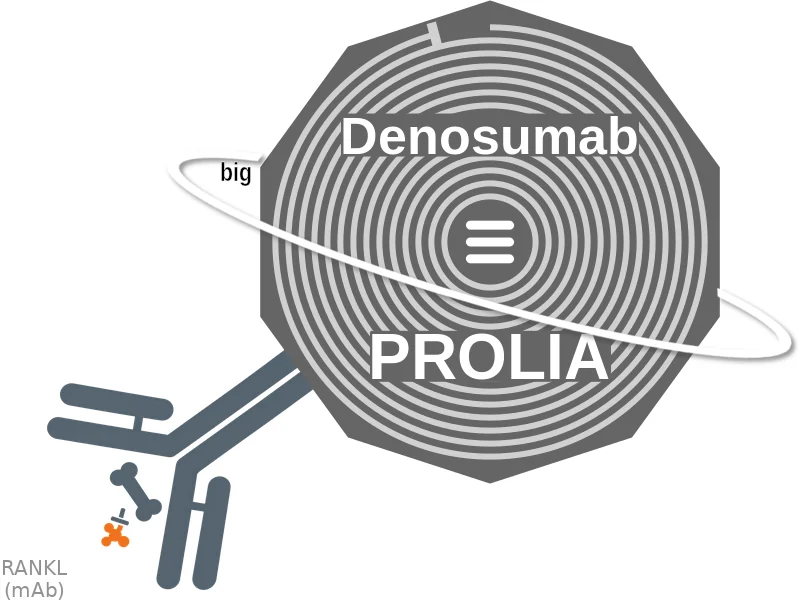
What it isRANK ligand antibody preventing osteoclast maturation; as PROLIA (60 mg SC every 6 months), osteoporosis and treatment-induced bone loss. Skeletal events in malignancy are XGEVA (120 mg), a separate product.
Why this oneNeeds no renal dose adjustment, unlike bisphosphonates, but advanced CKD sharply increases hypocalcemia risk.
What limits it⚑ Check and correct calcium before treatment; never stop without follow-on antiresorptive therapy because vertebral fractures can rebound.
Pearls
- Cuts vertebral, hip and nonvertebral fractures; no clear edge over bisphosphonates.
- Efficacy data support up to 10 years of continuous use.
- Osteonecrosis of the jaw and atypical femoral fractures, as with bisphosphonates.
- Interchangeable biosimilars exist for both PROLIA and XGEVA.
Denosumab prescription history
Animated chart of estimated U.S. prescriptions per year, Osteoporosis meds (1975–2026). Denosumab enters in 2010 (estimated).
FDA-approved for
- postmenopausal osteoporosis (2010)
- skeletal-related events in bone metastases
Off-label
- glucocorticoid-induced osteoporosis in men
Principal riskSevere rebound vertebral fractures if stopped without a follow-on agent
Classes and tags
Clinical profile
Legacy pregnancy categoryC
Defining liabilityHypocalcemia, osteonecrosis and rebound vertebral fractures if stopped without transition therapy.
FDA label
Read the full label on DailyMed ↗
| FDA dosing | Population | Start | Target | Max |
|---|---|---|---|---|
| Postmenopausal osteoporosis at high risk for fracture | Postmenopausal women | 60 mg SC once every 6 months | 60 mg SC once every 6 months | 60 mg every 6 months |
| Osteoporosis at high risk for fracture — to increase bone mass | Men | 60 mg SC once every 6 months | 60 mg SC once every 6 months | 60 mg every 6 months |
| Glucocorticoid-induced osteoporosis at high risk of fracture (≥7.5 mg/day prednisone equivalent, expected ≥6 months) | Men and women | 60 mg SC once every 6 months | 60 mg SC once every 6 months | 60 mg every 6 months |
| Bone loss on androgen deprivation therapy for nonmetastatic prostate cancer (high fracture risk) | Men | 60 mg SC once every 6 months | 60 mg SC once every 6 months | 60 mg every 6 months |
| Bone loss on adjuvant aromatase inhibitor therapy for breast cancer (high fracture risk) | Women | 60 mg SC once every 6 months | 60 mg SC once every 6 months | 60 mg every 6 months |
Renal No dose adjustment. Advanced CKD (eGFR <30 mL/min/1.73 m2, incl. dialysis): evaluate for CKD-MBD (iPTH, serum calcium, 25(OH) vitamin D, 1,25(OH)2 vitamin D) before starting; monitor serum calcium weekly for the first month, then monthly; adequate calcium and activated vitamin D.
Hepatic Undefined (no studies in hepatic impairment).
Instructions
- Administered by a healthcare provider: single SC injection in the upper arm, upper thigh, or abdomen — not into muscle or blood vessel.
- All patients: calcium 1000 mg daily and at least 400 IU vitamin D daily; correct pre-existing hypocalcemia before starting.
- Rule out pregnancy (test females of reproductive potential) before administration.
- Predisposed to hypocalcemia (no advanced CKD): check calcium, phosphorus and magnesium 10 to 14 days after injection.
- Missed dose: give as soon as possible, then every 6 months from the date of the last injection.
- May warm to room temperature (up to 25°C) in the original container, 15 to 30 minutes; do not warm any other way.
- Do not give with other denosumab products; if Prolia is stopped, transition to another antiresorptive (vertebral fracture risk).
Available strengths
- inj 60 mg/mL
Contraindications
- Hypocalcemia (correct pre-existing hypocalcemia before initiating)
- Pregnancy
Cautions
- Severe hypocalcemia and mineral metabolism changes (advanced CKD, calcimimetics)
- Drug products with same active ingredient — no concomitant denosumab products
- Hypersensitivity including anaphylaxis
- Osteonecrosis of the jaw
- Atypical subtrochanteric and diaphyseal femoral fractures
- Multiple vertebral fractures after discontinuation
- Serious infections (incl. skin infections, endocarditis)
- Dermatologic adverse reactions
- Severe musculoskeletal pain
- Suppression of bone turnover
- Hypercalcemia in pediatric patients with osteogenesis imperfecta (not approved in pediatrics)
Adverse reactions
- Postmenopausal osteoporosis: back pain, pain in extremity, hypercholesterolemia, musculoskeletal pain, cystitis
- Male osteoporosis: back pain, arthralgia, nasopharyngitis
- Glucocorticoid-induced osteoporosis: back pain, hypertension, bronchitis, headache
- Bone loss on ADT/aromatase inhibitor: arthralgia, back pain
Pregnancy Contraindicated — may cause fetal harm (monkey data: fetal loss, stillbirth, lymph node/bone abnormalities); use effective contraception during therapy and for at least 5 months after the last dose.
Lactation No human data on presence in milk or effects on infant/milk production; RANKL knockout mice showed impaired lactation.
Cost
| Strength | #/mo | generic $/unit | CostPlus | |
|---|---|---|---|---|
| 60 mg/mL | inj | per unit | $1559.53/mL | offered |
Generic entry2025 (biosimilar)
Open Denosumab in the interactive console ↗
Memory aids: interaction avatars
Open Denosumab in the interactive console ↗
Self-check
- What PROLIA dose and interval are stated?
60 mg SC every 6 months. - What must follow denosumab cessation to avoid rebound vertebral fractures?
Antiresorptive therapy.