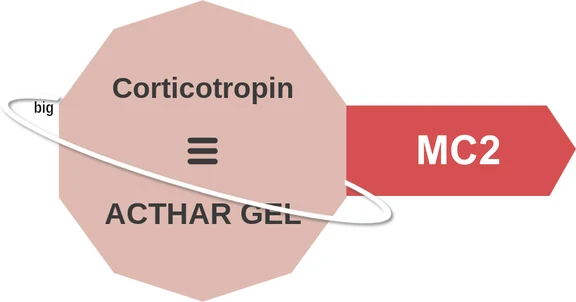
Corticotropin
ACTHAR GEL
What it isRepository ACTH gel stimulating adrenal cortisol production; infantile spasms, MS relapses, and inflammatory disease.
Why this oneIts strongest niche is infantile spasms, where a finite hormonal course can rapidly suppress the epileptic syndrome.
What limits itExtreme cost and reliance on an intact adrenal axis limit use; hypertension, hyperglycemia, and immunosuppression remain.
FDA-approved for
- infantile spasms (2010)
- multiple sclerosis relapses
- various inflammatory and rheumatic conditions
Off-label
- refractory epilepsies beyond infantile spasms
FDA label
Read the full label on DailyMed ↗
| FDA dosing | Population | Start | Target | Max |
|---|---|---|---|---|
| Infantile spasms | Infants/children <2 y | 150 U/m² per day IM (75 U/m² BID) ×2 wk, then taper over 2 wk | 150 U/m²/day IM | 150 U/m²/day |
| Acute exacerbations of multiple sclerosis | Adults | 80–120 U/day IM or SC ×2–3 wk | 80–120 U/day | 120 U/day |
| Other disorders/diseases | Adults | 40–80 U IM or SC q24–72h | 40–80 U q24–72h | 80 U |
Renal Undefined
Hepatic May have enhanced effect in liver cirrhosis; monitor
Instructions
- Taper dose to avoid adrenal insufficiency after prolonged therapy
- Infantile spasms must be given IM using the vial; suggested taper: 30 U/m² AM ×3 d, 15 U/m² AM ×3 d, 10 U/m² AM ×3 d, then 10 U/m² every other AM ×6 d
- SelfJect pre-filled injector is SC, adults only, for single 40 U or 80 U doses
Contraindications
- Intravenous administration
- Infants under 2 years with suspected congenital infections
- Concomitant live or live-attenuated vaccines in patients on immunosuppressive doses
- Scleroderma, osteoporosis, systemic fungal infections, ocular herpes simplex
- Recent surgery; history of or present peptic ulcer
- Congestive heart failure; uncontrolled hypertension
- Primary adrenocortical insufficiency or adrenocortical hyperfunction
- Sensitivity to proteins of porcine origin
Cautions
- Increased susceptibility to/masking of infections
- Adrenal insufficiency after prolonged therapy withdrawal; Cushing's syndrome
- Elevated blood pressure, salt/water retention, hypokalemia
- GI perforation and bleeding
- Behavioral/mood disturbances (euphoria, insomnia, psychosis, depression)
- Ophthalmic effects (cataracts, glaucoma); decreased bone density; growth suppression in children
Adverse reactions
- Injection site reactions
- Fatigue/malaise/asthenia
- Fluid retention/peripheral swelling
- Insomnia, headache, increased blood glucose
- (Infantile spasms) infections, convulsions, hypertension, irritability, pyrexia
Pregnancy May cause fetal harm via steroidogenic effect; hypoadrenalism reported in infants; observe newborns
Lactation No data on presence in human milk; weigh benefit vs risk
NO BOXED WARNINGS
Principal riskExtreme cost; it needs an intact adrenal axis
Cost, est. cash$100–$5,000/month
Generic entry1984
Classes and tags
Clinical profile
Legacy pregnancy categoryUnknown / historical label unavailable
Defining liabilityGenerally tolerated at therapeutic doses; clinically important risks are agent-specific and increase with interactions or organ impairment.
Mechanism of action: Corticotropin ballicule