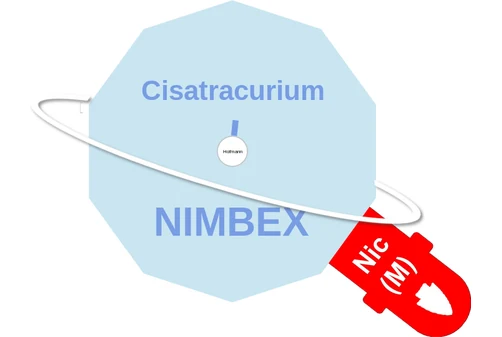
Cisatracurium
NIMBEX
What it isNondepolarizing muscle nicotinic-receptor antagonist cleared by Hofmann elimination; surgical and ICU paralysis.
Why this oneOrgan-independent clearance with little histamine release makes it especially useful in critically ill patients.
What limits itIts slow onset makes it unsuitable for rapid-sequence intubation. Paralysis provides no sedation or analgesia.
FDA-approved for
- neuromuscular blockade (surgery) (1995)
FDA label
Read the full label on DailyMed ↗
| FDA dosing | Population | Start | Target | Max |
|---|---|---|---|---|
| Tracheal intubation | Adult | 0.15-0.2 mg/kg IV bolus | 0.4 mg/kg (studied) | |
| Maintenance neuromuscular blockade | Adult | 0.03 mg/kg IV bolus | ||
| Neuromuscular disease (intubation) | Adult | max initial bolus 0.02 mg/kg | 0.02 mg/kg | |
| Continuous infusion (surgical) | Adult/peds ≥2 y | 3 mcg/kg/min | 1-2 mcg/kg/min | |
| ICU mechanical ventilation | Adult | 3 mcg/kg/min | 0.5-10.2 mcg/kg/min | |
| Tracheal intubation | Infant 1-23 mo | 0.15 mg/kg IV | ||
| Tracheal intubation | Child 2-12 y | 0.1-0.15 mg/kg IV |
Renal No adjustment needed (recovery profile unchanged; time to blockade ~1 min slower in end-stage renal disease)
Hepatic No adjustment needed (minor PK differences; no clinically significant change in recovery)
First maintenance bolus 40-50 min after 0.15 mg/kg initial dose (50-60 min after 0.2 mg/kg).
Instructions
- IV use only; administer by/under supervision of experienced clinicians with resuscitation available
- Use a peripheral nerve stimulator to monitor depth of blockade and guide dosing
- Reduce infusion rate ~30-40% during stable isoflurane/inhalational anesthesia; halve rate for CABG with induced hypothermia
- Consider increased doses in burn patients (resistance to nondepolarizing blockers)
Cautions
- Residual paralysis (higher risk in neuromuscular disease); extubate only after adequate recovery
- Seizure risk from laudanosine metabolite with prolonged use in renal/hepatic impairment
- Severe hypersensitivity/anaphylaxis; cross-reactivity among neuromuscular blockers
- Risk of death from medication errors (accidental administration)
- Requires adequate sedation/anesthesia (awareness while paralyzed)
- Neuromuscular blockade potentiated by certain drugs and electrolyte/acid-base abnormalities
- Malignant hyperthermia (not studied)
Adverse reactions
- Bradycardia
- Hypotension
- Flushing
- Bronchospasm
- Rash
Pregnancy No human data; no maternal or fetal toxicity in animals. 10 mL multiple-dose vial contains benzyl alcohol — use a benzyl alcohol-free formulation in pregnancy.
Lactation No data on presence in human milk; 10 mL multiple-dose vial contains benzyl alcohol — consider a benzyl alcohol-free formulation.
NO BOXED WARNINGS
Principal riskNo sedation whatever; slow onset
Classes and tags
Clinical profile
Mechanism of action: Cisatracurium ballicule