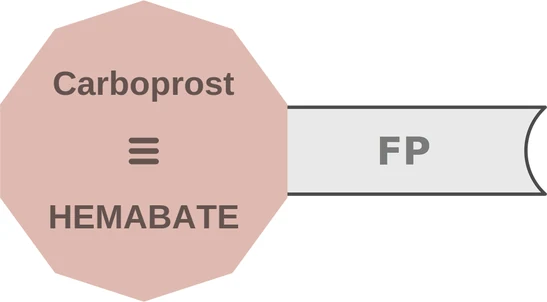
Carboprost
HEMABATE
What it isProstaglandin FP-receptor agonist causing uterine contraction; refractory postpartum hemorrhage.
Why this oneIt contracts the uterus when oxytocin fails and, unlike methylergonovine, is not primarily limited by hypertension.
What limits itBronchospasm can be severe, so avoid it in asthma. Diarrhea, vomiting and fever are common.
FDA label
Read the full label on DailyMed ↗
BOXED WARNING Potent oxytocic — use only with strict adherence to recommended dosages; administer by medically trained personnel in a hospital with immediate intensive care and acute surgical facilities
| FDA dosing | Population | Start | Target | Max |
|---|---|---|---|---|
| Abortion (label indications 1–4) | Adults | 250 mcg (1 mL) deep IM; optional 100 mcg (0.4 mL) test dose initially | 250 mcg IM q1.5–3.5h by uterine response; may increase to 500 mcg (2 mL) if contractility inadequate after several 250 mcg doses | Total ≤12 mg; continuous administration >2 days not recommended |
| Refractory postpartum uterine bleeding | Adults | 250 mcg deep IM ×1 (73% responded to a single injection) | May repeat at 15–90 min intervals per clinical course | Total ≤2 mg (8 doses) |
Renal Active renal disease: contraindicated
Hepatic Active hepatic disease: contraindicated
Instructions
- Deep IM injection (tuberculin syringe)
- Pretreat/concurrently give antiemetics and antidiarrheals to reduce very high incidence of GI effects
- Inspect visually for particulate matter and discoloration before administration
Contraindications
- Acute pelvic inflammatory disease
- Active cardiac, pulmonary, renal, or hepatic disease
Cautions
- Use only recommended doses; hospital setting with intensive care and surgical facilities (boxed)
- Transient temperature elevation; distinguish from endometritis
- May cause transient bronchoconstriction
- May augment other oxytocics — concomitant use not recommended
Adverse reactions
- Vomiting and diarrhea (~2/3 of patients), nausea (~1/3)
- Temperature increase >2°F (~1/8), flushing (~1/14)
- Endometritis, retained placental fragments, excessive uterine bleeding (~1/50 post-abortion complications requiring treatment)
- Post-marketing: hypersensitivity (anaphylaxis, anaphylactic shock, angioedema)
Pregnancy Oxytocic used to evacuate the uterus; animal studies not teratogenic but embryotoxic in rats and rabbits — any dose that increases uterine tone puts the embryo/fetus at risk
Lactation Undefined
NO BOXED WARNINGS
Classes and tags
Clinical profile
Mechanism of action: Carboprost ballicule