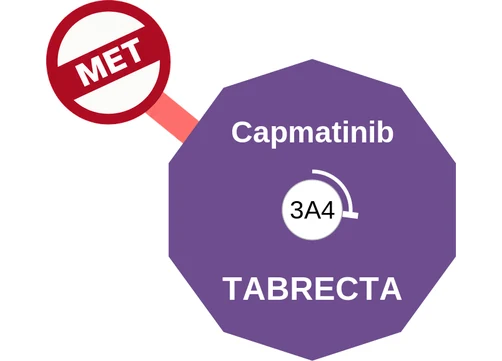
Capmatinib
TABRECTA
What it isOral MET tyrosine-kinase inhibitor; metastatic non-small-cell lung cancer with MET exon-14 skipping.
Why this oneIt was the first MET inhibitor approved for exon-14-skipping lung cancer and can work in brain metastases.
What limits itPneumonitis, hepatotoxicity, edema, and marked photosensitivity require monitoring; CYP3A interactions alter exposure.
FDA label
Read the full label on DailyMed ↗
| FDA dosing | Population | Start | Target | Max |
|---|---|---|---|---|
| Metastatic NSCLC with mutation leading to MET exon 14 skipping (tumor or plasma specimen) | Adults | 400 mg BID | Continue until progression or unacceptable toxicity | 400 mg BID |
Renal Mild-moderate (CLcr 30-89 mL/min): no adjustment; severe (CLcr 15-29): not studied
Hepatic Undefined (not addressed in extracted sections)
Dose reductions for toxicity: 1st 300 mg BID, 2nd 200 mg BID; permanently discontinue if 200 mg BID not tolerated. Any-grade ILD/pneumonitis: permanently discontinue
Instructions
- Swallow tablets whole; do not break, crush, or chew
- With or without food
- Missed or vomited dose: do not make up; take next dose at scheduled time
- Limit direct ultraviolet exposure (photosensitivity risk)
Cautions
- ILD/pneumonitis, can be fatal (4.8%; Grade 3 1.9%) — permanently discontinue for any grade
- Hepatotoxicity — monitor LFTs at baseline, q2 weeks for first 3 months, then monthly
- Pancreatic toxicity — monitor amylase/lipase at baseline and regularly
- Hypersensitivity reactions — withhold or permanently discontinue by severity
- Photosensitivity — sunscreen/protective clothing, limit UV exposure
- Embryo-fetal toxicity — effective contraception (females and males) during treatment and for 1 week after last dose
Adverse reactions
- Most common (>=20%): edema (59%), nausea (46%), musculoskeletal pain (40%), fatigue (34%), vomiting (28%), dyspnea (25%), cough (21%), decreased appetite (21%)
- Serious ARs in 53%: dyspnea, pneumonia, pleural effusion; fatal pneumonitis 0.3%
Pregnancy Can cause fetal harm — malformations in rats/rabbits at exposures below human 400 mg BID exposure; verify pregnancy status before starting; no human data
Lactation No human or animal milk data — advise not to breastfeed during treatment and for 1 week after last dose
NO BOXED WARNINGS
Principal riskNo FDA boxed warning.
Cost, est. cash$5,000–$30,000+/month or cycle
Generic entry2035 est.
Classes and tags
Clinical profile
Legacy pregnancy categoryNot assigned — PLLR-era drug
Defining liabilityMyelosuppression and agent-specific hepatic, cardiac, pulmonary, neurologic or reproductive toxicity require oncology monitoring.
Mechanism of action: Capmatinib ballicule