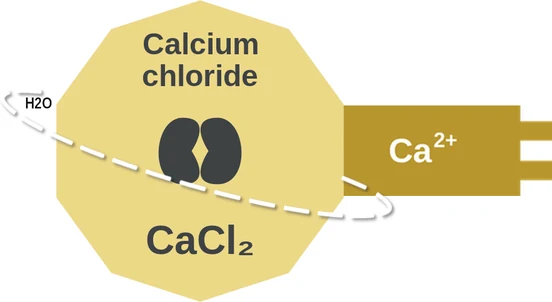
Calcium chloride
CaCl₂
What it isConcentrated IV calcium-repletion salt for severe hypocalcemia, hyperkalemia, and calcium-channel-blocker overdose.
Why this oneIt provides roughly three times the elemental calcium of calcium gluconate per ampule, making it the code-cart calcium for resuscitation.
What limits itIt is vesicant enough to demand a central line or emergency-only peripheral use — extravasation causes necrosis.
FDA label
Read the full label on DailyMed ↗
| FDA dosing | Population | Start | Target | Max |
|---|---|---|---|---|
| Acute symptomatic hypocalcemia | Adults | 200-1,000 mg slow IV infusion (max 1 mL/min = 100 mg/min) via central or deep vein; individualize by ionized calcium, symptom severity, acuity | 1,000 mg/dose; repeat PRN (rapid calcium excretion) | |
| Acute symptomatic hypocalcemia | Pediatric | 2.7-5 mg/kg slow IV infusion via central or deep vein | 5 mg/kg/dose; repeat PRN | |
| Acute symptomatic hypocalcemia — renal impairment | Adults (renal impairment) | 200 mg slow IV (lowest recommended dose) | ||
| Acute symptomatic hypocalcemia — renal impairment | Pediatric (renal impairment) | 2.7 mg/kg slow IV (lowest recommended dose) |
Renal Start at lowest recommended dose (adults 200 mg; peds 2.7 mg/kg); monitor serum calcium frequently (e.g., q4h) — risk of high calcium-phosphorus product
Hepatic Undefined
This vial cannot deliver doses <200 mg — use another product for smaller doses. Repeat injections may be required due to rapid calcium excretion
Instructions
- Slow IV only, in a central or deep vein; max rate 1 mL/min (100 mg/min); no bolus
- NEVER IM or SC (tissue necrosis, calcinosis cutis); avoid extravasation — stop immediately if perivascular infiltration
- Stop if administration-related discomfort; may resume when symptoms resolve
- Do not mix with other drugs; never mix or Y-site with ceftriaxone; in patients >28 days, ceftriaxone may be given sequentially only with thorough line flushing
- Warm solution to body temperature if time permits; do not use if unclear or seal broken; discard unused portion
Contraindications
- Ventricular fibrillation
- Asystole and electromechanical dissociation
- Newborns (<=28 days) requiring, or expected to require, IV ceftriaxone — ceftriaxone-calcium precipitates (fatal cases), regardless of timing or separate lines
Cautions
- End-organ damage from intravascular ceftriaxone-calcium precipitates (fatal in neonates)
- Rapid administration (>1 mL/min): hypotension, bradycardia, arrhythmias, syncope
- Digoxin: avoid concomitant use; if necessary monitor ECG and calcium closely
- Tissue necrosis, ulceration, calcinosis with extravasation or IM/SC injection
- Aluminum toxicity with prolonged use in renal impairment (premature neonates at particular risk); limit total aluminum exposure to <=5 mcg/kg/day in parenteral nutrition
Adverse reactions
- Paraesthesia and calcium taste (rapid injection); sense of oppression or 'heat wave'
- Local burning, injection-site extravasation/reactions
- Peripheral vasodilatation, decreased blood pressure
Pregnancy Treatment of acute symptomatic hypocalcemia not expected to cause fetal harm; maternal hypocalcemia itself risks abortion, dysfunctional labor, preeclampsia, and neonatal complications
Lactation Calcium is present in human milk; recommended doses not expected to harm a breastfed infant
NO BOXED WARNINGS
Classes and tags
Clinical profile
Mechanism of action: Calcium chloride ballicule