Brimonidine
ALPHAGAN
Pronunciation: bri-MOE-ni-deen
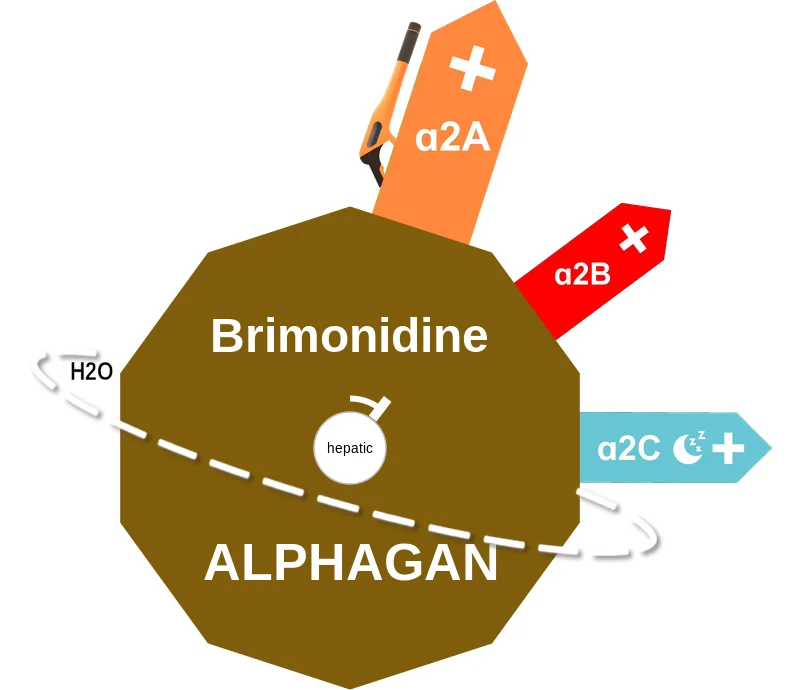

“Brimo, needy Alpha agonist”
orange plus signs → alpha-2 agonist
What it isTopical alpha-2 agonist that reduces aqueous production or constricts cutaneous vessels; glaucoma and rosacea.
Why this oneLowers intraocular pressure without beta blockade and its facial gel directly blanches persistent rosacea erythema.
What limits itSomnolence and apnea can occur in small children; ocular allergy and rebound facial redness can end treatment.
Pearls
- Contraindicated under age 2; caution ages 2–6.
- Rosacea gel fades redness only; papules and pustules unaffected.
- Systemic absorption: fatigue and drowsiness even in adults.
Brimonidine prescription history
Animated chart of estimated U.S. prescriptions per year, Glaucoma medicines (1900–2026). Brimonidine enters in 1996 (estimated).
FDA-approved for
- glaucoma (1996)
- rosacea (2013)
Principal riskSomnolence, marked in small children
Classes and tags
Clinical profile
Legacy pregnancy categoryUnknown / historical label unavailable
Defining liabilityGenerally tolerated at therapeutic doses; clinically important risks are agent-specific and increase with interactions or organ impairment.
FDA label
Read the full label on DailyMed ↗
NO BOXED WARNINGS
| FDA dosing | Population | Start | Target | Max |
|---|---|---|---|---|
| Reduction of elevated IOP in open-angle glaucoma or ocular hypertension | adults & children ≥2 y | 1 drop affected eye(s) TID (~8 h apart) | 1 drop TID | 1 drop TID |
Renal Undefined
Hepatic Undefined
Instructions
- Instill 1 drop in affected eye(s) three times daily, ~8 hours apart
- May be used with other topical ophthalmic IOP-lowering products; instill different products ≥5 minutes apart
- Do not touch dispenser tip to eye (contamination/bacterial keratitis risk)
Available strengths
- drops 0.025, 0.1, 0.15, 0.2 %
- sol 1.5, 2 mg/mL
- gel 0.33 %
Contraindications
- Neonates and infants (younger than 2 years)
Cautions
- May potentiate vascular insufficiency — caution in depression, cerebral or coronary insufficiency, Raynaud's phenomenon, orthostatic hypotension, thromboangiitis obliterans
- Caution in severe cardiovascular disease
- Contaminated multi-dose containers have caused bacterial keratitis
- Pediatric ≥2 y: somnolence and decreased alertness common (less frequent ≥7 y/>20 kg)
Adverse reactions
- Allergic conjunctivitis
- Conjunctival hyperemia
- Eye pruritus
- Burning sensation
- Conjunctival folliculosis
- Hypertension
- Ocular allergic reaction
- Oral dryness
- Visual disturbance
Pregnancy No adequate human studies; crosses placenta in animals; use only if benefit justifies fetal risk
Lactation Unknown if in human milk (present in rat milk); not recommended during lactation — risk of CNS depression and apnea in nursing infants
Cost
| Strength | #/mo | generic $/unit | CostPlus | |
|---|---|---|---|---|
| 0.025 % | drops | per unit | not offered | |
| 0.1 % | drops | per unit | not offered | |
| 0.15 % | drops | per unit | not offered | |
| 0.2 % | drops | per unit | not offered |
Generic entry2003
Open Brimonidine in the interactive console ↗
Self-check
- What serious effects can brimonidine cause in small children?
Somnolence and apnea. - What does brimonidine facial gel directly blanch?
Persistent rosacea erythema.