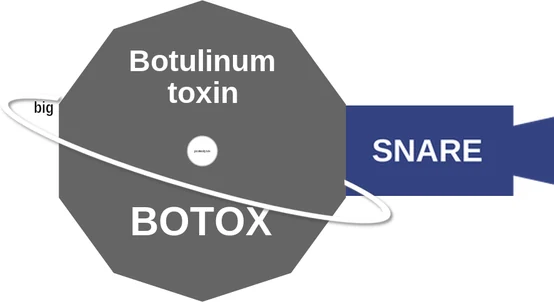
Botulinum toxin
BOTOX
What it isSNARE-cleaving inhibitor of acetylcholine release; dystonia, spasticity, migraine, hyperhidrosis, and cosmesis.
Why this oneA local injection produces prolonged, reversible chemodenervation with little systemic exposure.
What limits itDistant spread can cause dysphagia or respiratory weakness; potency units are not interchangeable across products.
FDA-approved for
- dystonia/spasticity/migraine/cosmetic (1989)
FDA label
Read the full label on DailyMed ↗
| FDA dosing | Population | Start | Target | Max |
|---|---|---|---|---|
| Glabellar lines (moderate-severe) | Adults | 40 Units IM per session | 8 Units (0.1 mL) IM × 5 sites (2 per corrugator, 1 procerus) = 40 Units per session | 40 Units per session; no more often than q3 months |
| Cervical dystonia | Adults | 125–250 Units IM per session, divided among affected muscles | 125–250 Units per session; adjust in 50–75 Unit increments to response | 250 Units per session; no more often than q3 months |
Titration No dose increase within a session; adjust only at the next treatment session, which must be ≥3 months later.
Renal Undefined
Hepatic Undefined
Administer no more frequently than every 3 months for any indication; account for cumulative dose and for any other botulinum toxin products the patient is receiving.
Instructions
- IM injection only, after reconstitution with preservative-free 0.9% Sodium Chloride Injection, USP.
- Units are NOT interchangeable with any other botulinum toxin product — do not convert doses.
- Reconstitution: 50 Unit vial + 0.6 mL diluent → 8 Units/0.1 mL (glabellar). 100 Unit vial + 1.2 mL → 8 Units/0.1 mL (glabellar); 100 Unit vial + 1 mL or 2 mL → 10 or 5 Units/0.1 mL (cervical dystonia).
- Inject diluent slowly; discard the vial if vacuum does not draw the diluent in. Mix by gentle rotation. Do not use if cloudy, discolored, or containing flakes/particles.
- Administer within 72 h of reconstitution; store reconstituted product at 2–8°C protected from light; do not freeze.
- Single-dose vial: one injection session, one patient; discard remaining solution immediately.
- Glabellar lines: do not inject less than 1 cm above the superior orbital rim; avoid injection near the levator palpebrae superioris to reduce ptosis; use a 30–33 gauge needle and expel air bubbles.
- Cervical dystonia: limit the dose injected into the sternocleidomastoid to reduce dysphagia.
Contraindications
- Infection at the proposed injection site(s)
Cautions
- Spread of toxin effect: asthenia, generalized weakness, diplopia, blurred vision, ptosis, dysphagia, dysphonia, dysarthria, urinary incontinence, breathing difficulty — seek immediate care.
- Potency Units are not interchangeable with other botulinum toxin preparations.
- Dysphagia and breathing difficulty; dysphagia may persist months and aspiration/respiratory failure and death have occurred — caution with pre-existing swallowing or respiratory compromise (neck muscle weakening can remove accessory ventilation).
- Serious/immediate hypersensitivity including anaphylaxis, serum sickness, urticaria, soft-tissue edema, dyspnea — stop injecting and treat.
- Cardiovascular events (arrhythmia, MI), some fatal — caution with pre-existing cardiovascular disease.
- Pre-existing neuromuscular disease (peripheral motor neuropathy, ALS, myasthenia gravis, Lambert-Eaton) — monitor for increased neuromuscular compromise at typical doses.
- Serious adverse reactions (excessive weakness, dysphagia, aspiration pneumonia, deaths) reported with unapproved uses.
- Glabellar lines: caution with altered facial anatomy, marked asymmetry, excessive dermatochalasis, deep dermal scarring, thick sebaceous skin, injection-site inflammation, pre-existing eyelid/brow ptosis, or target-muscle weakness/atrophy.
- Dry eye / reduced tear production, reduced blinking, corneal disorders — refer persistent symptoms to ophthalmology.
Adverse reactions
- Glabellar lines (≥1%): headache 6%, eyelid ptosis 2%, facial paresis 1%; injection-site reactions 6% (same as placebo).
- Cervical dystonia (≥5%): headache 9%, injection site pain 8%, injection site erythema 5%, muscular weakness 5%, upper respiratory tract infection 5%.
- Cervical dystonia, other ≥2%: musculoskeletal pain 4%, dysphagia 2–4%, nasopharyngitis 3%, spinal pain 2–3%, arthralgia 2%, UTI 2%, first-degree AV block 2%.
- Onset typically 1–2 weeks post-injection; generally transient but may last weeks to months. Repeat dosing did not increase incidence.
Pregnancy No human data; in animals, IM dosing in pregnancy decreased fetal body weight and skeletal ossification at maternally toxic doses ~40× the MRHD (no embryofetal toxicity at 15× in rats).
Lactation No data on presence in human or animal milk or effects on the breastfed infant — weigh benefits of breastfeeding against maternal need.
⚠ BOXED WARNING
- Distant spread of toxin effect
Cost, est. cash$600–$2,000/session
Generic entryNo US generic
Classes and tags
Clinical profile
Legacy pregnancy categoryUnknown / historical label unavailable
Defining liabilityDistant toxin spread can cause dysphagia, generalized weakness and respiratory compromise.
Mechanism of action: Botulinum toxin ballicule