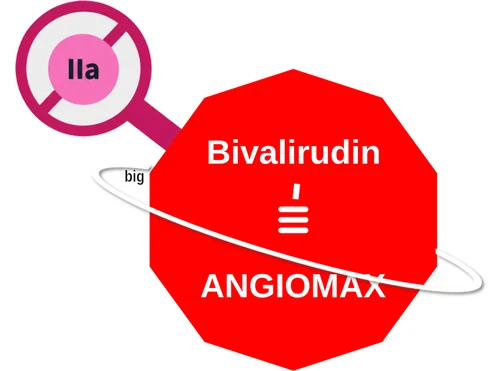
Bivalirudin
ANGIOMAX
What it isA bivalent direct thrombin inhibitor, used principally as procedural anticoagulation in PCI and in HIT.
Why this oneIts short half-life and largely enzymatic clearance make it a predictable, quickly reversible-by-time infusion in the cath lab.
What limits itNo antidote exists, and renal impairment prolongs its effect despite the enzymatic clearance.
FDA label
Read the full label on DailyMed ↗
| FDA dosing | Population | Start | Target | Max |
|---|---|---|---|---|
| Percutaneous coronary intervention (PCI); used with aspirin | Adults | 0.75 mg/kg IV bolus, then 1.75 mg/kg/h IV infusion for duration of procedure | 1.75 mg/kg/h IV infusion for procedure duration | Additional 0.3 mg/kg IV bolus if needed (per ACT at 5 min); extend infusion up to 4 h post-PCI in STEMI |
Renal CrCl <30 mL/min: reduce infusion to 1 mg/kg/h; on hemodialysis: reduce to 0.25 mg/kg/h; no bolus reduction; monitor anticoagulant status/ACT
Hepatic Undefined
Extend infusion up to 4 hours post-procedure in STEMI patients undergoing primary PCI
Instructions
- IV bolus injection followed by continuous infusion after reconstitution and dilution
- Reconstitute each 250 mg vial with 5 mL Sterile Water for Injection; dilute to 5 mg/mL in D5W or 0.9% NaCl
- Perform ACT 5 min after bolus; give additional 0.3 mg/kg bolus if needed
- Do not administer in same IV line with alteplase, amiodarone, amphotericin B, chlorpromazine, diazepam, dobutamine, prochlorperazine, reteplase, streptokinase, or vancomycin
Contraindications
- Active major bleeding
Cautions
- Increases risk of bleeding; unexplained fall in BP or hematocrit should prompt consideration of hemorrhage and cessation
- Acute stent thrombosis (<4 h) in STEMI patients undergoing primary PCI; monitor ≥24 h post-PCI
- Increased thrombotic risk (including fatal) with coronary artery gamma brachytherapy; maintain meticulous catheter technique
Adverse reactions
- Bleeding (>2%), including major bleeding events (3.7% in BAT trials: intracranial, retroperitoneal, overt bleed)
- Post-marketing: fatal bleeding, hypersensitivity/anaphylaxis, thrombus formation during PCI, pulmonary hemorrhage, cardiac tamponade, INR increased
Pregnancy No available human data; animal reproduction studies (rats/rabbits SC up to 1.6×/3.2× MRHD) revealed no evidence of fetal harm.
Lactation Unknown whether present in human milk; no data on effects on breastfed child or milk production.
NO BOXED WARNINGS
Classes and tags
Clinical profile
Mechanism of action: Bivalirudin ballicule