Bempedoic acid
NEXLETOL
What it isATP-citrate lyase inhibitor acting upstream of HMG-CoA reductase; hyperlipidemia and ASCVD risk reduction.
Why this oneActivation occurs in liver rather than skeletal muscle, making muscle symptoms less central than with statins.
What limits itHyperuricemia, gout, and tendon rupture can end treatment; it also raises exposure to some statins.
FDA-approved for
- hyperlipidemia / ASCVD risk reduction (2020)
FDA label
Read the full label on DailyMed ↗
| FDA dosing | Population | Start | Target | Max |
|---|---|---|---|---|
| Reduce risk of major adverse cardiovascular events (CV death, MI, stroke, coronary revascularization) in adults at increased risk unable to take recommended statin therapy | Adult | 180 mg QD | 180 mg QD | 180 mg QD |
| Hypercholesterolemia incl. HeFH — adjunct to diet/exercise, with other LDL-C-lowering therapy or alone when concomitant therapy not possible | Adult | 180 mg QD | 180 mg QD | 180 mg QD |
Renal Undefined
Hepatic No adjustment for mild or moderate impairment (Child-Pugh A or B); severe (Child-Pugh C) not studied
Instructions
- Take once daily with or without food
- Analyze lipid levels within 8-12 weeks after initiation
- Missed dose: take as soon as possible; do not double next dose
Cautions
- Hyperuricemia — inhibits renal OAT2; may precipitate gout (gout 3.2% vs 2.2% placebo in CV outcomes trial); assess uric acid as indicated and treat with urate-lowering drugs as appropriate
- Tendon rupture (rotator cuff, biceps, Achilles; 0.5-1.2%) — discontinue immediately at first sign of rupture; consider discontinuing for joint pain/swelling/inflammation; consider alternatives in patients with tendon-disorder history; risk higher >60 yr, with corticosteroids/fluoroquinolones, renal failure
Adverse reactions
- Upper respiratory tract infection
- Muscle spasms
- Hyperuricemia, gout
- Back pain, abdominal pain, pain in extremity
- Bronchitis
- Anemia
- Elevated liver enzymes
- Renal impairment, cholelithiasis (CV outcomes trial)
Pregnancy Discontinue when pregnancy recognized unless benefits outweigh risks; may cause fetal harm based on mechanism (decreases cholesterol synthesis); insufficient human data
Lactation Detected in human breast milk (mean RID ~0.5%); may cause harm to breastfed infant; weigh benefits of breastfeeding against need and risk
NO BOXED WARNINGS
Principal riskHyperuricemia and gout; tendon rupture
Cost, est. cash$300–$2,500/month
Generic entry2040 est.
Classes and tags
Clinical profile
Legacy pregnancy categoryNot assigned — PLLR-era drug
Defining liabilityMyopathy/rhabdomyolysis and hepatotoxicity; interaction burden varies by agent.
Mechanism of action: Bempedoic acid ballicule
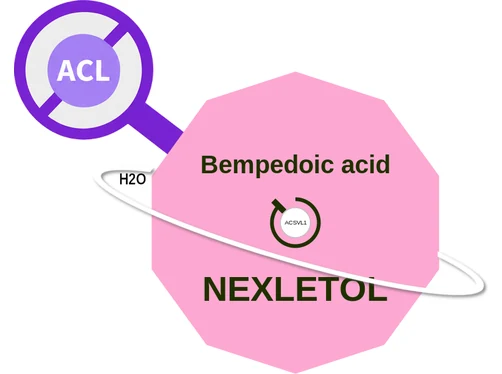
Open Bempedoic acid in the interactive console ↗
Memory aids: mascots and interaction avatars