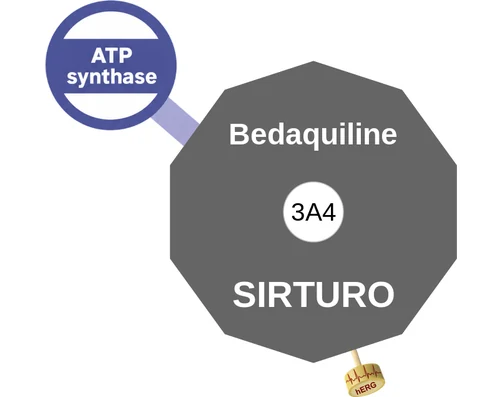
Bedaquiline
SIRTURO
What it isA diarylquinoline that inhibits mycobacterial ATP synthase, for multidrug-resistant tuberculosis.
Why this oneIt was the first genuinely new TB mechanism in four decades and anchors the modern all-oral MDR-TB regimens.
What limits itQT prolongation — additive with other QT-prolonging TB drugs — and a very long tissue half-life are its liabilities, with a boxed mortality signal from its pivotal trial.
FDA label
Read the full label on DailyMed ↗
| FDA dosing | Population | Start | Target | Max |
|---|---|---|---|---|
| Pulmonary TB resistant to at least rifampin and isoniazid (combination therapy) | Adults | 400 mg QD x 2 wks (with food) | then 200 mg 3x/wk (>=48 h between doses) x 22 wks; 24 wks total; may continue 200 mg 3x/wk beyond 24 wks if needed | 400 mg/day (wks 1-2); weekly total not to exceed recommended weekly dose |
| Pulmonary TB resistant to at least rifampin and isoniazid (combination therapy) | Peds >=2 yr and >=8 kg, weight-banded | Wks 1-2 QD: 8-<10 kg 80 mg; 10-<15 kg 120 mg; 15-<30 kg 200 mg; >=30 kg 400 mg | Wks 3-24, 3x/wk (>=48 h apart): 8-<10 kg 40 mg; 10-<15 kg 60 mg; 15-<30 kg 100 mg; >=30 kg 200 mg | Per weight band; beyond 24 wks only if >=16 yr and >=30 kg (200 mg 3x/wk) |
Renal Mild-moderate: no adjustment. Severe/ESRD on dialysis: use with caution; monitor for adverse reactions
Hepatic Mild-moderate: no adjustment. Severe: not studied — use with caution only if benefit outweighs risk; monitor
At least 48 h between 3x/wk doses; weekly total must not exceed recommended weekly dose with >=24 h between intakes
Instructions
- Take with food; administer by directly observed therapy (DOT); complete full course
- Use only with >=3 other drugs to which the isolate is susceptible (>=4 if susceptibility results unavailable)
- Before starting: ECG, serum K/Ca/Mg, liver enzymes, susceptibility testing
- 100 mg tablet: swallow whole with water
- 20 mg tablet: whole or split at score (10 mg halves); or disperse in water (+/- beverage/soft food), crush into soft food, or give via feeding tube >=8 Fr
- Missed dose wks 1-2: skip it. Wk 3 on: take ASAP, resume 3x/wk schedule
- Avoid alcohol and other hepatotoxic drugs during treatment
Cautions
- QTc prolongation: ECG at baseline, 2 wks after start, and during treatment; correct electrolytes; added risk with other QTc drugs, TdP or congenital long-QT history, hypothyroidism, bradyarrhythmias, uncompensated heart failure, low K/Ca/Mg; discontinue if QTc >500 ms (repeat-confirmed) or significant ventricular arrhythmia; ECG if syncope
- Unexplained mortality imbalance vs placebo in Study 1 (11.4% vs 2.5%)
- Hepatotoxicity: monitor symptoms and ALT/AST/ALP/bilirubin at baseline, monthly, and prn; discontinue if AST/ALT >8x ULN, >5x ULN persisting >2 wks, or transaminase rise with bilirubin >2x ULN
- Avoid moderate/strong CYP3A4 inducers (rifampin, rifapentine, rifabutin, efavirenz); monitor safety closely with CYP3A4 inhibitors
- Use only in an appropriate combination regimen to limit bedaquiline resistance
Adverse reactions
- Adults >=10%: nausea, arthralgia, headache, hemoptysis, chest pain (Study 1); QTc prolongation, vomiting, transaminase increase, abdominal pain, pruritus, dizziness, rash, insomnia, dry skin, palpitations (Study 4)
- Peds >=10%: arthralgia, nausea, abdominal pain (12-<18 yr); liver-enzyme elevation (5-<12 yr); vomiting (2-<5 yr)
Pregnancy Insufficient human data; no fetal harm in rat/rabbit studies up to 6x clinical exposure. Untreated active TB in pregnancy carries maternal/neonatal risk
Lactation Accumulates in breast milk (concentrations exceed maternal plasma); breastfeeding not recommended during treatment and for 27.5 months after last dose unless formula unavailable; monitor breastfed infants for hepatotoxicity
NO BOXED WARNINGS
Classes and tags
Clinical profile
Mechanism of action: Bedaquiline ballicule