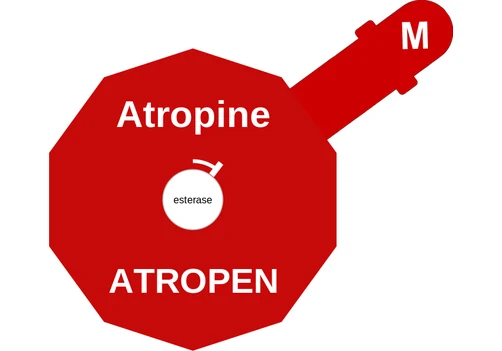
Atropine
ATROPEN
What it isAntimuscarinic; symptomatic bradycardia, organophosphate poisoning and secretion control.
Why this oneIt reverses vagally mediated bradycardia within a minute, and in organophosphate poisoning it is titrated to drying of secretions with no ceiling dose.
What limits itIt crosses into the CNS, causing delirium in the elderly. Ineffective in infranodal block and in transplanted hearts.
FDA-approved for
- bradycardia/organophosphate poisoning (~1960)
Off-label
- clozapine-induced sialorrhea (sublingual drops)
FDA label
Read the full label on DailyMed ↗
| FDA dosing | Population | Start | Target | Max |
|---|---|---|---|---|
| Antisialagogue / other antivagal use | Adults | 0.5-1 mg IV | Repeat q1-2h PRN | Titrate to HR, PR interval, BP, symptoms |
| Organophosphorus or muscarinic mushroom poisoning | Adults | 2-3 mg IV | Repeat q20-30min PRN | Titrate to effect |
| Bradyasystolic cardiac arrest | Adults | 1 mg IV | Repeat q3-5min | 3 mg total |
| All uses (not well studied) | Pediatric | 0.01-0.03 mg/kg IV initial | Titrate to effect | Undefined |
Renal Undefined
Hepatic Undefined
Repeat-dose spacing is per indication (q1-2h antivagal; q20-30min poisoning; q3-5min arrest, 3 mg cap)
Instructions
- IV administration; titrate based on heart rate, PR interval, blood pressure, and symptoms
- Single-dose syringe — discard unused portion; do not administer unless solution clear and seal intact
- Coronary artery disease: limit total dose to 0.03-0.04 mg/kg (2-3 mg) to avoid tachycardia-driven myocardial oxygen demand
Cautions
- Tachycardia: in CAD, restrict total dose to 2-3 mg (max 0.03-0.04 mg/kg)
- May precipitate acute glaucoma
- May convert partial organic pyloric stenosis into complete obstruction
- May cause complete urinary retention in prostatic hypertrophy
- May inspissate bronchial secretions and form viscid plugs in chronic lung disease
Adverse reactions
- Common (antimuscarinic): dry mouth, blurred vision, photophobia, tachycardia
- Anhidrosis with heat intolerance
- Elderly: constipation, difficulty in micturition
- Occasional hypersensitivity — skin rashes, sometimes progressing to exfoliation
Pregnancy Animal reproduction studies not conducted; unknown whether atropine causes fetal harm — Undefined risk
Lactation Trace amounts found in breast milk; clinical impact unknown
NO BOXED WARNINGS
Principal riskDelirium in the elderly from CNS penetration
Cost, est. cash$10–$400/month
Generic entry2020
Classes and tags
Clinical profile
Legacy pregnancy categoryC
Defining liabilityGenerally tolerated at therapeutic doses; clinically important risks are agent-specific and increase with interactions or organ impairment.
Mechanism of action: Atropine ballicule