Ascorbic acid
VITAMIN C
What it isVitamin C cofactor for collagen, catecholamine, and epigenetic enzymes; prevents and treats scurvy.
Why this oneScurvy's bleeding and poor wound healing reflect failed collagen hydroxylation and distinguish this deficiency.
What limits itHigh exposure can promote oxalate stones and distort some glucose-meter and stool occult-blood results.
FDA-approved for
- scurvy / vitamin C deficiency
FDA label
Read the full label on DailyMed ↗
| FDA dosing | Population | Start | Target | Max |
|---|---|---|---|---|
| Scurvy (vitamin C deficiency) | 5 to <12 mo | 50 mg IV QD (infuse 1.3 mg/min) | 50 mg IV QD | 50 mg/day; max 7 days; no repeat course <11 yr |
| Scurvy (vitamin C deficiency) | 1 to <11 yr | 100 mg IV QD (infuse 3.3 mg/min) | 100 mg IV QD | 100 mg/day; max 7 days; no repeat course <11 yr |
| Scurvy (vitamin C deficiency) | Adults & peds >=11 yr | 200 mg IV QD (infuse 33 mg/min) | 200 mg IV QD | 200 mg/day; max 7 days/course (retreat if symptoms persist) |
Renal No adjustment specified; renal disease/oxalate-stone history raises oxalate-nephropathy risk — monitor renal function; discontinue if nephropathy develops
Hepatic Undefined
Repeat dosing not recommended in patients <11 yr
Instructions
- Slow IV infusion only — never undiluted; dilute to 1-25 mg/mL in a suitable solution and make final admixture isotonic
- Pharmacy bulk vial (25,000 mg): dispense single doses only; never give vial contents to one patient; use within 4 h of puncture
- Protect from light; inspect — solution should be colorless to pale yellow
- Pregnancy, lactation, or G6PD deficiency: do not exceed the RDA/adequate-intake for age and condition
- Maximum treatment duration 1 week; if scorbutic symptoms persist, retreat until resolution (adults/>=11 yr)
Cautions
- Oxalate nephropathy and nephrolithiasis with prolonged high doses — higher risk in renal disease, oxalate-stone history, geriatric patients, and children <2 yr; monitor renal function
- Hemolysis in G6PD deficiency — use reduced dose (<=RDA), monitor hemoglobin/blood count; discontinue if hemolysis suspected
- Interferes with redox-based laboratory tests, incl. blood/urine glucose (false results)
Adverse reactions
- Infusion-site pain and swelling (most common)
- Rapid infusion (>250 mg/min): faintness, nausea, lethargy, flushing, dizziness, headache
- Oxalate nephropathy (prolonged high doses)
- Severe hemolysis (G6PD deficiency)
Pregnancy Decades of use without reported adverse developmental outcomes; do not exceed the pregnancy RDA.
Lactation Present in human milk after oral intake; intake above the RDA does not raise milk levels — follow the lactation RDA.
NO BOXED WARNINGS
Principal riskOxalate stones at high dose; it skews glucose meters
Classes and tags
Clinical profile
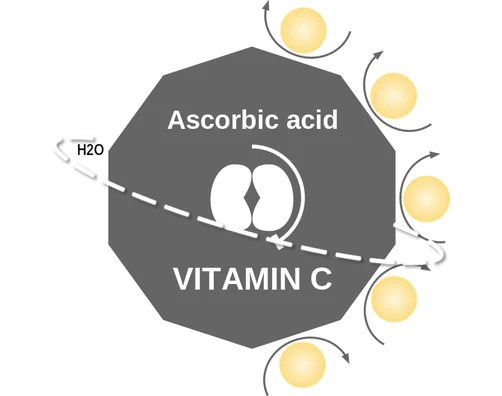
Mechanism of action: Ascorbic acid ballicule
Open Ascorbic acid in the interactive console ↗
Memory aids: mascots and interaction avatars