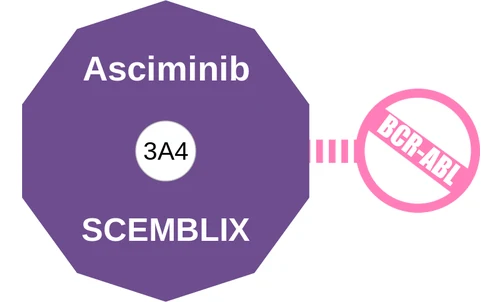
Asciminib
SCEMBLIX
What it isAllosteric BCR-ABL1 inhibitor binding the myristoyl pocket rather than the ATP site; chronic myeloid leukemia.
Why this oneIts distinct binding site can retain activity after ATP-site inhibitors fail, including against T315I disease.
What limits itMyelosuppression, pancreatic-enzyme elevation or pancreatitis, hypertension, and arterial events require monitoring.
FDA label
Read the full label on DailyMed ↗
| FDA dosing | Population | Start | Target | Max |
|---|---|---|---|---|
| Ph+ CML in chronic phase (newly diagnosed or previously treated) | Adults | 80 mg QD or 40 mg BID (~12 h apart) | 80 mg QD or 40 mg BID | 80 mg/day |
| Ph+ CML-CP with T315I mutation | Adults | 200 mg BID (~12 h apart) | 200 mg BID | 400 mg/day |
Renal No adjustment needed (mild-severe, eGFR 15-89, not requiring dialysis)
Hepatic No adjustment needed (mild-severe)
Dose-reduce for adverse reactions: CML-CP 40 mg QD or 20 mg BID; T315I 160 mg BID; discontinue if not tolerated
Instructions
- Take without food; avoid food >=2 h before and 1 h after each dose
- Swallow tablets whole; do not break, crush, or chew
- Missed dose: skip if >~12 h late (QD regimen) or >~6 h late (BID regimens); take next dose as scheduled
Cautions
- Myelosuppression — CBC q2wk for first 3 months, then monthly; manage by interruption/dose reduction
- Pancreatic toxicity — monitor lipase/amylase monthly; evaluate for pancreatitis if elevation with abdominal symptoms
- Hypertension (18%) — monitor BP; interrupt/reduce/stop if not medically controlled
- Hypersensitivity (rash, edema, bronchospasm)
- Cardiovascular toxicity (ischemic, thromboembolic, cardiac failure, arrhythmia incl. QTc prolongation) — monitor patients with CV risk factors
- Embryo-fetal toxicity — verify pregnancy status; effective contraception during and 1 wk after
Adverse reactions
- Musculoskeletal pain
- Rash
- Fatigue
- Upper respiratory tract infection
- Headache
- Abdominal pain
- Arthralgia
- Diarrhea
- Labs: decreased lymphocytes/leukocytes/platelets/neutrophils/hemoglobin; increased lipase, cholesterol, triglycerides, uric acid, ALT/AST/ALP, CK, amylase
Pregnancy Can cause fetal harm (animal malformations at <=human exposure); verify pregnancy status before starting; contraception during and 1 wk after last dose
Lactation Do not breastfeed during treatment and for 1 week after last dose
NO BOXED WARNINGS
Principal riskNo FDA boxed warning.
Cost, est. cash$5,000–$30,000+/month or cycle
Generic entry2040 est.
Classes and tags
Clinical profile
Legacy pregnancy categoryNot assigned — PLLR-era drug
Defining liabilityMyelosuppression and agent-specific hepatic, cardiac, pulmonary, neurologic or reproductive toxicity require oncology monitoring.
Mechanism of action: Asciminib ballicule