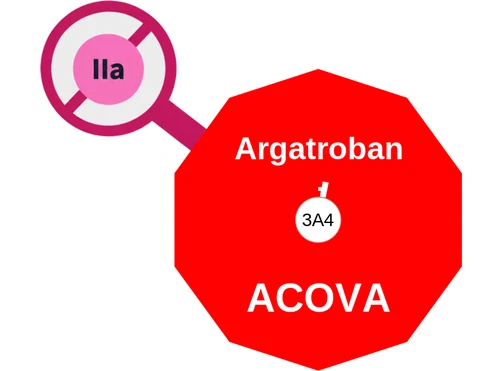
Argatroban
ACOVA
What it isA synthetic direct thrombin inhibitor given by IV infusion, the standard anticoagulant for heparin-induced thrombocytopenia.
Why this oneIt has no cross-reactivity with HIT antibodies and, being hepatically cleared, works in the renal failure that often accompanies HIT.
What limits itIt has no antidote, and it raises the INR independently of warfarin — complicating the transition, which must overlap with an adjusted INR target.
FDA label
Read the full label on DailyMed ↗
| FDA dosing | Population | Start | Target | Max |
|---|---|---|---|---|
| Heparin-induced thrombocytopenia (HIT) — prophylaxis/treatment of thrombosis | Adults (no hepatic impairment) | IV 2 mcg/kg/min continuous infusion (discontinue heparin, obtain baseline aPTT first) | aPTT 1.5–3× baseline (not >100 sec); check 2 h after start and after any dose change | IV 10 mcg/kg/min |
| PCI in patients with or at risk for HIT | Adults (no hepatic impairment) | IV bolus 350 mcg/kg over 3–5 min + infusion 25 mcg/kg/min | ACT 300–450 sec (check 5–10 min after bolus/rate change); 15–30 mcg/kg/min per ACT | IV 40 mcg/kg/min with additional 150 mcg/kg boluses (procedural complications) |
Titration HIT: recheck aPTT 2 h after initiation/any change before adjusting; PCI: recheck ACT 5–10 min after each bolus or rate change
Renal Undefined
Hepatic HIT with moderate–severe impairment (Child-Pugh): start IV 0.5 mcg/kg/min, titrate carefully (clearance ↓4-fold; reversal may take >4 h). Avoid in PCI with clinically significant hepatic disease or AST/ALT ≥3× ULN
Instructions
- Dilute 100-fold to 1 mg/mL in NS, D5W, or LR before infusion; do not mix with other drugs
- Continued anticoagulation after PCI: 2 mcg/kg/min adjusted to aPTT
- Warfarin conversion: no warfarin loading dose; overlap therapies; at argatroban ≤2 mcg/kg/min stop argatroban when INR >4 on combined therapy, recheck INR 4–6 h after stopping; at >2 mcg/kg/min first reduce to 2 mcg/kg/min and recheck INR in 4–6 h
Contraindications
- Major bleeding
Cautions
- Hemorrhage can occur at any site — unexplained fall in hematocrit or BP may indicate bleeding; intracranial and retroperitoneal hemorrhage reported
- Increased bleeding risk: severe hypertension, recent lumbar puncture/spinal anesthesia/major surgery (brain, spinal cord, eye), bleeding disorders, GI lesions; concomitant antiplatelets/thrombolytics/anticoagulants
- Hepatic impairment: reduced clearance, prolonged anticoagulant effect after stopping
- aPTT is the monitoring test for HIT dosing; PT/INR prolonged beyond warfarin alone during coadministration
Adverse reactions
- HIT (>5%): dyspnea, hypotension, fever, diarrhea, sepsis, cardiac arrest
- PCI (>5%): chest pain, hypotension, back pain, nausea, vomiting, headache
- Bleeding: GI and GU/hematuria most common; major bleeding 5.3% in HIT trials
Pregnancy Limited data suggest no association with adverse fetal outcomes; anticoagulant use risks bleeding in mother and fetus — monitor
Lactation No data on presence in human milk (present in rat milk); weigh benefit vs risk
NO BOXED WARNINGS
Classes and tags
Clinical profile
Mechanism of action: Argatroban ballicule