Apomorphine
APOKYN
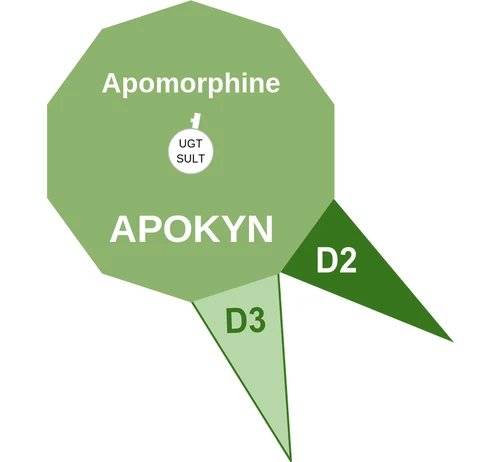
What it isD2/D3 dopamine-receptor agonist; rescue therapy for Parkinson OFF episodes.
Why this oneSubcutaneous rescue acts faster than oral levodopa when mobility suddenly fails.
What limits it5-HT3 antiemetics are contraindicated because the combination can cause severe hypotension; nausea, orthostasis, and somnolence remain.
FDA-approved for
- Parkinson OFF episodes (2004)
FDA label
Read the full label on DailyMed ↗
| FDA dosing | Population | Start | Target | Max |
|---|---|---|---|---|
| Parkinson's disease — motor fluctuations / OFF episodes; continuous SC infusion | Adults | 1 mg/hr continuous SC infusion | Titrate to response; mean 4 mg/hr in trials | 6 mg/hr over the waking day (e.g. 16 h); 98 mg total/day incl. extra doses |
| Parkinson's disease — extra (as-needed) dose for acute OFF symptoms, morning start, or restart after ≥1 h break | Adults | 0.5 mg SC | Titrate in 0.1–1 mg increments to response | 2 mg per extra dose; 3 extra doses/day |
| Parkinson's disease — extra (as-needed) dose | Adults, mild or moderate renal impairment | 0.5–1 mg SC | 0.5–1 mg SC | 1 mg initial extra dose |
| Antiemetic premedication for ONAPGO-induced nausea/vomiting | Adults | Trimethobenzamide 300 mg TID, starting 3 days before first ONAPGO dose | Trimethobenzamide 300 mg TID | Generally no longer than 2 months after ONAPGO initiation |
Titration Continuous dosage: titrate in 0.1 mg/hr to 1 mg/hr increments; adjustments may be made daily or at longer intervals.
Renal Mild or moderate impairment: initial extra dose 0.5–1 mg, not to exceed 1 mg; no adjustment to the continuous dose, maximum daily dose, or subsequent extra doses. Severe impairment: not studied.
Hepatic Mild or moderate impairment: exercise caution and monitor closely (increased Cmax/AUC). Severe impairment: not studied.
At least 3 hours between extra doses; no more than 3 extra doses per day; total daily dose (continuous + extra) ≤98 mg over the waking day (e.g. 16 h).
Instructions
- Subcutaneous infusion ONLY via the ONAPGO pump — never IV (IV crystallization has caused thrombus and pulmonary embolism).
- Express the prescription as mg/hr for the continuous dose and mg for extra doses.
- Initiate and titrate under medical supervision; patient or caregiver must be trained on the delivery system first.
- Premedicate with trimethobenzamide 300 mg TID starting 3 days before the first dose; alternatively start at 1 mg/hr without an antiemetic. Stop trimethobenzamide as soon as nausea is controlled, generally within 2 months (it increases somnolence, dizziness and falls).
- Inspect the solution before use — should be clear and almost colorless; discard if discolored or particulate.
- Infuse into the abdomen (≥2 inches from the navel), top of thigh, lower back, or upper back (upper back only if prepared by a caregiver/HCP); avoid bruised, nodular or irritated sites.
- Change the infusion site every day; use aseptic technique. Use a new single-dose cartridge and cartridge holder each day and discard the unused portion.
- TAPER before stopping — sudden discontinuation or rapid dose reduction can worsen Parkinson's motor symptoms.
- Avoid alcohol. Lie down before and after taking sublingual nitroglycerin.
- If a prolonged interruption occurs (e.g. infusion-site infection), prescribe oral Parkinson's medication in the interim.
- Adjust concomitant anti-Parkinson's medication as needed after starting.
Contraindications
- Concomitant 5-HT3 antagonists — antiemetics (ondansetron, granisetron, dolasetron, palonosetron) and alosetron: profound hypotension and loss of consciousness reported.
Cautions
- Do NOT give IV — thrombus formation and pulmonary embolism from IV crystallization.
- Nausea and vomiting, may be severe; anti-dopaminergic antiemetics (haloperidol, chlorpromazine, promethazine, prochlorperazine, metoclopramide) may worsen Parkinson's.
- Somnolence (22%) and falling asleep during activities of daily living, including driving, sometimes without warning — ordinarily discontinue if it occurs.
- Hypotension/orthostatic hypotension and syncope, especially during dose escalation; additive with alcohol, vasodilators and antihypertensives.
- Increased risk of falls.
- Infusion-site reactions (63%) and infections (4%, most often cellulitis) — monitor and rotate site daily; remove the cannula if infection is suspected.
- Hallucinations and psychotic-like behavior, delusions, confusion, agitation, delirium; weigh risks before use in major psychotic disorder.
- Dyskinesia, new or worsened (~15%).
- Hemolytic anemia, sometimes requiring hospitalization, often Coombs-positive — work up new anemia and consider discontinuation.
- Impulse control/compulsive behaviors (gambling, sexual urges, spending) — ask directly; consider dose reduction or stopping.
- Cardiac events — MI, tachycardia, palpitations, bundle branch block; cardiac arrest and sudden death reported with SC apomorphine.
- QTc prolongation with risk of torsades de pointes or sudden death.
- Hypersensitivity including angioedema and anaphylaxis (contains sodium metabisulfite).
- Fibrotic complications.
- Priapism.
- Elderly: confusion, hallucinations, falls, cardiovascular, respiratory and GI events and discontinuations reported more often in patients ≥65 yr.
Adverse reactions
- Infusion site nodule (44%)
- Nausea (22%)
- Somnolence (22%)
- Infusion site erythema (17%)
- Dyskinesia (15%)
- Headache (13%)
- Insomnia (11%)
- Dizziness (9%)
- Hypotension (7%), asthenia (7%), fatigue (7%), constipation (7%), vomiting (7%)
Pregnancy No adequate human data; animal studies showed increased neonatal death (rats) and cardiac/great-vessel malformations (rabbits) at clinically relevant doses — may cause fetal harm.
Lactation No data on presence in human milk, effects on the breastfed infant, or on milk production; weigh benefits of breastfeeding against maternal need.
NO BOXED WARNINGS
Principal riskSevere hypotension with ondansetron
Cost, est. cash$10–$300/month
Generic entry2022
Classes and tags
Clinical profile
Legacy pregnancy categoryC
Defining liabilityRespiratory depression, dependence and overdose; risk rises sharply with sedatives or impaired clearance.
Mechanism of action: Apomorphine ballicule
Open Apomorphine in the interactive console ↗
Memory aids: mascots and interaction avatars

SQ injection → “a pokin’”