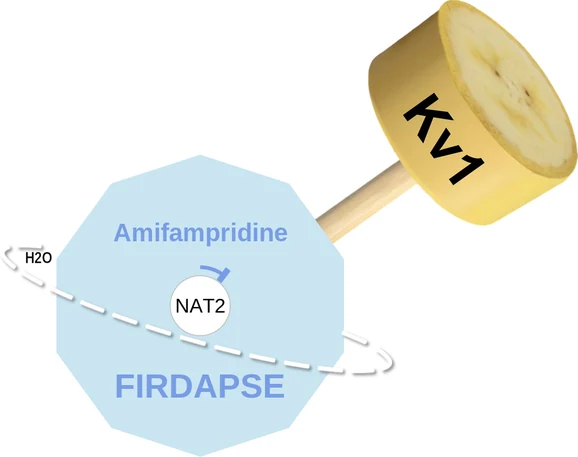
Amifampridine
FIRDAPSE
What it isPotassium-channel blocker prolonging nerve-terminal depolarization; Lambert-Eaton myasthenic syndrome.
Why this oneIt increases acetylcholine release presynaptically, directly addressing the defect in Lambert-Eaton syndrome.
What limits itSeizures can occur at higher exposure. Paresthesia is common, and NAT2 acetylator status markedly changes exposure.
FDA-approved for
- Lambert-Eaton myasthenic syndrome (2018)
FDA label
Read the full label on DailyMed ↗
| FDA dosing | Population | Start | Target | Max |
|---|---|---|---|---|
| Lambert-Eaton myasthenic syndrome (LEMS) | Adults & peds ≥45 kg (≥6 yr) | 15–30 mg/day in 3–5 divided doses | titrate to response | 20 mg/dose; 100 mg/day |
| Lambert-Eaton myasthenic syndrome (LEMS) | Peds <45 kg (≥6 yr) | 5–15 mg/day in 3–5 divided doses | titrate to response | 10 mg/dose; 50 mg/day |
Titration ≥45 kg: increase by 5 mg/day every 3–4 days. <45 kg: increase by 2.5 mg/day every 3–4 days.
Renal Start at lowest initial daily dosage (CrCl 15–90); no recommendation in ESRD.
Hepatic Start at lowest initial daily dosage for any degree of impairment.
Maximum single dose 20 mg (≥45 kg) or 10 mg (<45 kg).
Instructions
- Give in divided doses (3–5×/day), with or without food.
- Known NAT2 poor metabolizers: start at lowest initial daily dosage.
- A 1 mg/mL suspension may be prepared for small dose increments or feeding tubes.
Contraindications
- History of seizures
Cautions
- Seizures (can occur ~2%, may be dose-dependent)
- Hypersensitivity/anaphylaxis (reported with other aminopyridines)
Adverse reactions
- Paresthesia
- Upper respiratory tract infection
- Abdominal pain
- Nausea
- Diarrhea
- Headache
- Elevated liver enzymes
- Back pain
- Hypertension
- Muscle spasms
Pregnancy No human data; animal developmental toxicity (stillbirths, pup deaths, delayed development) at subtherapeutic exposures.
Lactation No human data; excreted in rat milk at levels similar to maternal plasma.
NO BOXED WARNINGS
Principal riskSeizures at higher doses
Cost, est. cash$300–$2,500/month
Generic entry2037 est.
Classes and tags
Clinical profile
Legacy pregnancy categoryNot assigned — PLLR-era drug
Defining liabilityGenerally tolerated at therapeutic doses; clinically important risks are agent-specific and increase with interactions or organ impairment.
Mechanism of action: Amifampridine ballicule