Alirocumab
PRALUENT
What it isPCSK9-inhibiting monoclonal antibody; familial hypercholesterolemia and residual ASCVD risk despite statins.
Why this oneIts outcome evidence comes from patients after acute coronary syndrome, unlike evolocumab's stable-ASCVD trial population.
What limits itInjection burden, access, cost, and local reactions are the practical limits.
FDA-approved for
- hyperlipidemia / ASCVD risk reduction (2015)
FDA label
Read the full label on DailyMed ↗
| FDA dosing | Population | Start | Target | Max |
|---|---|---|---|---|
| Primary hyperlipidemia, incl. HeFH | Adults | 75 mg q2wk or 300 mg q4wk SC | Adjust to 150 mg q2wk if LDL-C response inadequate | |
| HeFH with LDL apheresis, or HoFH | Adults | 150 mg q2wk SC | ||
| HeFH | Peds ≥8 yr, <50 kg | 150 mg q4wk SC | Adjust to 75 mg q2wk if inadequate | |
| HeFH | Peds ≥8 yr, ≥50 kg | 300 mg q4wk SC | Adjust to 150 mg q2wk if inadequate |
Renal No adjustment for mild-moderate impairment; no data in severe impairment
Hepatic No adjustment for mild-moderate impairment; no data in severe impairment
Instructions
- Inject subcutaneously into thigh, abdomen, or upper arm; rotate sites
- For the 300 mg dose, give two 150 mg injections consecutively at two different sites
- Allow to warm to room temperature 30-40 minutes if refrigerated
- Missed dose: give within 7 days and resume schedule; if >7 days, follow label per dosing interval
Cautions
- Serious hypersensitivity reactions (hypersensitivity vasculitis, angioedema) requiring hospitalization — discontinue if they occur
Adverse reactions
- Injection site reactions, influenza, diarrhea, myalgia, muscle spasms
Pregnancy Insufficient data. As an IgG antibody, alirocumab crosses the placenta (increasingly near term).
Lactation No information on presence in human milk; breast-milk IgG is unlikely to enter the infant circulation in substantial amounts.
NO BOXED WARNINGS
Principal riskInjection-site reactions
Cost, est. cash$300–$5,000/dose or month
Generic entry2031 est. (biosimilar)
Classes and tags
Clinical profile
Legacy pregnancy categoryUnknown / historical label unavailable
Defining liabilityInjection-site and hypersensitivity reactions; systemic acute toxicity is minimal.
Mechanism of action: Alirocumab ballicule
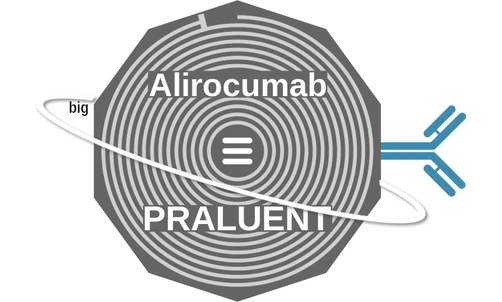
Open Alirocumab in the interactive console ↗
Memory aids: mascots and interaction avatars

Pesky K-9 → PCSK9, on a leash (mAb blockade)
PCSK9 targets LDL receptors for destruction