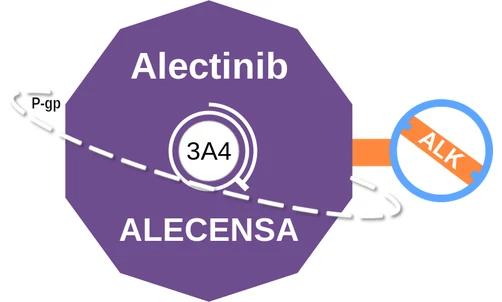
Alectinib
ALECENSA
What it isALK tyrosine-kinase inhibitor; ALK-positive non-small-cell lung cancer.
Why this oneExcellent CNS penetration and better tolerability than crizotinib make it a preferred first-line agent.
What limits itMyalgia, anemia, hepatotoxicity, bradycardia, and photosensitivity require monitoring; take with food.
FDA-approved for
- ALK-positive non-small cell lung cancer (2015)
FDA label
Read the full label on DailyMed ↗
| FDA dosing | Population | Start | Target | Max |
|---|---|---|---|---|
| ALK-positive NSCLC, adjuvant (resected) | Adults | 600 mg BID with food | 600 mg BID | |
| ALK-positive metastatic NSCLC | Adults | 600 mg BID with food | 600 mg BID |
Renal No adjustment for mild-moderate impairment; not studied in severe impairment (CrCl <30 mL/min) or ESRD
Hepatic Mild-moderate (Child-Pugh A/B): no adjustment; severe (Child-Pugh C): 450 mg BID
Instructions
- Swallow capsules whole; do not open or dissolve
- Take with food
- If a dose is missed or vomiting occurs, take the next dose at the scheduled time
- Adjuvant: treat for 2 years or until recurrence/unacceptable toxicity; metastatic: until progression/unacceptable toxicity
- Dose-reduce for adverse reactions: 450 mg BID, then 300 mg BID; discontinue if 300 mg BID not tolerated
Cautions
- Hepatotoxicity — monitor LFTs every 2 weeks for first 3 months, then monthly
- Interstitial lung disease/pneumonitis — withhold and discontinue if confirmed
- Renal impairment (including fatal cases)
- Bradycardia — monitor heart rate and blood pressure
- Severe myalgia and CPK elevation — assess CPK
- Hemolytic anemia
- Embryo-fetal toxicity — effective contraception
Adverse reactions
- Hepatotoxicity, constipation, fatigue, myalgia, edema, rash, cough
- Lab: increased CPK, decreased hemoglobin, increased ALT/AST/bilirubin
Pregnancy Can cause fetal harm (animal embryo-fetal toxicity/abortion). Verify pregnancy status; use effective contraception during and 5 weeks after last dose.
Lactation Do not breastfeed during treatment and for 1 week after the last dose.
NO BOXED WARNINGS
Principal riskMyalgia and photosensitivity
Cost, est. cash$5,000–$30,000+/month or cycle
Generic entry2035 est.
Classes and tags
Clinical profile
Legacy pregnancy categoryUnknown / historical label unavailable
Defining liabilityMyelosuppression and agent-specific hepatic, cardiac, pulmonary, neurologic or reproductive toxicity require oncology monitoring.
Mechanism of action: Alectinib ballicule