Not available in the U.S.
Aceclidine
VIZZ
What it isMuscarinic agonist eye drop; glaucoma and presbyopia.
Why this oneIt constricts the pupil with less ciliary spasm than pilocarpine, so near vision improves without the brow ache.
What limits itNot US-approved for glaucoma. Dim vision in low light; avoid in retinal disease.
FDA-approved for
- presbyopia (2025)
- glaucoma (non-US)
Off-label
- glaucoma (approved in Europe)
FDA label
Read the full label on DailyMed ↗
| FDA dosing | Population | Start | Target | Max |
|---|---|---|---|---|
| Presbyopia | Adult | 1 drop each eye, wait 2 min, then a 2nd drop each eye, QD | 1 drop each eye ×2 (2 min apart) QD | QD |
Renal Undefined
Hepatic Undefined
Instructions
- Remove contact lenses before instillation; may reinsert 10 minutes after.
- If using another topical ophthalmic, separate by at least 5 minutes.
- Use the same single-dose vial for both drops; discard after use.
- Avoid touching the vial tip to the eye or any surface.
Cautions
- Blurred/dim vision — do not drive or operate machinery until vision is clear; caution with night driving.
- Rare retinal tear/detachment with miotics — examine retina before therapy; seek care for sudden flashes, floaters, or vision loss.
- Caution in patients with a history of iritis (may exacerbate synechiae).
- Not recommended with known hypersensitivity to aceclidine.
Adverse reactions
- Instillation-site irritation (20%)
- Dim vision (16%)
- Headache (13%)
- Conjunctival hyperemia (8%)
- Ocular hyperemia (7%)
Pregnancy No adequate human data; oral animal studies showed no adverse maternal/fetal effects at clinically relevant doses.
Lactation No data on presence in human milk; systemic levels low after topical ocular use.
NO BOXED WARNINGS
Principal riskNot US-approved for glaucoma
Classes and tags
Clinical profile
Mechanism of action: Aceclidine ballicule
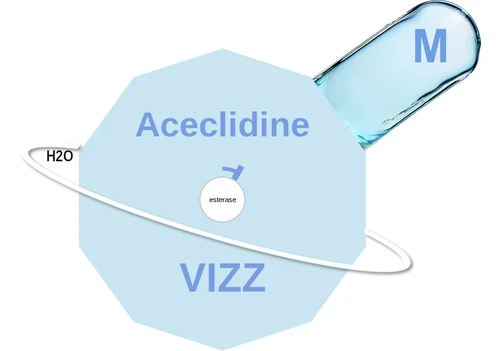
Open Aceclidine in the interactive console ↗
Memory aids: mascots and interaction avatars