Hepatitis A and E / viral hepatitis overview
- A/E → fecal–oral; B/C/D can spread via blood.
- HAV: anti-HAV IgM supports acute infection; no chronic HAV.
- HEV: anti-HEV IgM ± HEV RNA; severe risk in pregnancy, chronicity with immunosuppression.
- A/E usually self-limited → supportive care.
- HAVRIX prevents A only; no U.S.-licensed HEV vaccine.
Use at a glance
- A/E → fecal–oral; B/C/D can spread via blood.
- HAV: anti-HAV IgM supports acute infection; no chronic HAV.
- HEV: anti-HEV IgM ± HEV RNA; severe risk in pregnancy, chronicity with immunosuppression.
- A/E usually self-limited → supportive care.
- HAVRIX prevents A only; no U.S.-licensed HEV vaccine.
Self-check
- What is hepatitis?
Liver inflammation. - What are three nonviral causes of hepatitis?
Drugs, toxins, and autoimmune disease. - How can viral hepatitis injure liver cells?
Direct viral damage or the body’s immune response.
Significance: Injured liver cells can release enzymes into the blood. - What are the usual phases of symptomatic acute hepatitis?
Flu-like onset → possible jaundice → recovery. - What does icterus (IK-tuh-rus) mean?
Jaundice: yellow skin or eyes.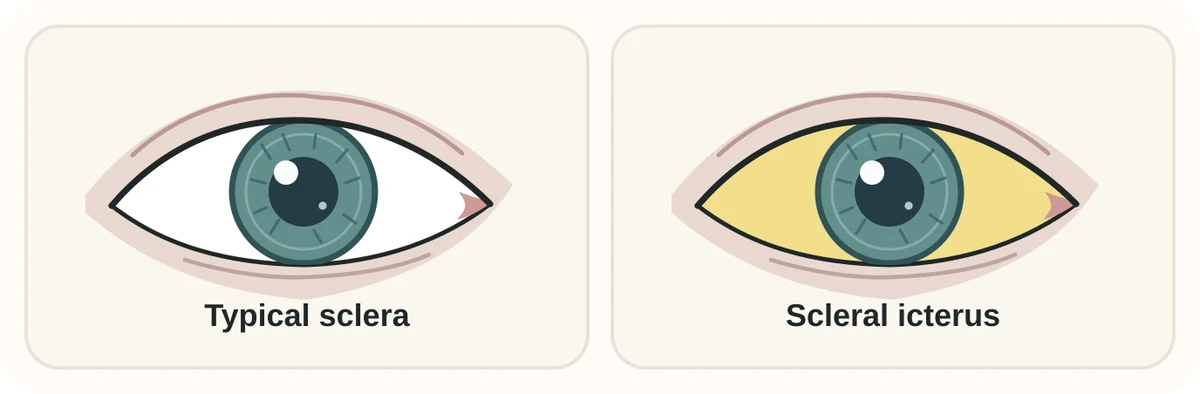
- What is hyperbilirubinemia (hy-per-bil-ih-roo-bih-NEE-mee-uh)?
Too much bilirubin (bil-ih-ROO-bin) in the blood.
Significance: High levels can come from poor liver processing or blocked bile. - What is hepatomegaly (hep-uh-toh-MEG-uh-lee)?
Enlarged liver. - Which common hepatitis viruses can become chronic?
B, C, and D. - How does hepatitis A (HAV) spread?
Fecal–oral, often through contaminated food or water.
HAV = hepatitis A virus - Does hepatitis A become chronic?
No.
Significance: Symptoms can return briefly without becoming chronic. - What suggests symptomatic hepatitis A?
Sudden fever, belly pain, dark urine, or jaundice. Young children often have no symptoms. - Which test supports acute hepatitis A?
IgM anti-HAV antibody.
Significance: Total antibody alone doesn’t show whether infection is recent.
IgM = immunoglobulin M • anti-HAV = antibody to hepatitis A virus - How is active hepatitis A treated?
Supportive care, such as fluids and rest. - What can prevent hepatitis A after exposure?
Vaccine, sometimes with immune globulin (GAMASTAN).
Significance: Post-exposure prevention is time-sensitive: within 2 weeks. - How does hepatitis E (HEV) usually spread?
Fecal–oral, mainly through contaminated water.
HEV = hepatitis E virus - Is hepatitis E usually short-term?
Yes. Rarely chronic with a weakened immune system.
Significance: Organ transplant recipients are especially vulnerable to chronic infection. - Who is at higher risk of severe hepatitis E?
Pregnant people, especially later in pregnancy.
All clinical uses · Open Hepatitis A and E / viral hepatitis overview in the interactive console ↗
Open Hepatitis A and E / viral hepatitis overview in slides ↗