Cobenfy
Combination product
Pronunciation: zan-OE-me-leen and TROES-pee-um (koe-BEN-fee)
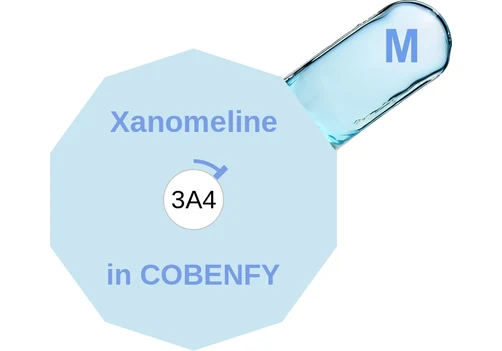
What it isXanomeline, an M1/M4-preferring muscarinic agonist, co-formulated with trospium, a peripherally restricted antimuscarinic; schizophrenia in adults.
Why this oneThe first schizophrenia treatment that does not block D2, so no extrapyramidal or prolactin effect; trospium blunts xanomeline’s peripheral cholinergic effects.
What limits itTwice daily on an empty stomach (1 h before or 2 h after a meal). Contraindicated in urinary or gastric retention, untreated narrow-angle glaucoma and moderate–severe hepatic impairment.

“Co-benefit”
Components (2)

FDA-approved for
- schizophrenia (2024)
FDA label
Read the full label on DailyMed ↗
| FDA dosing | Population | Start | Target | Max |
|---|---|---|---|---|
| Schizophrenia | Adults | 50/20 mg BID | 100/20 mg BID; may increase to 125/30 mg BID per tolerability/response | 125/30 mg BID |
| Schizophrenia | Geriatric | 50/20 mg BID (slower titration) | 100/20 mg BID | 100/20 mg BID |
Titration ≥2 days on 50/20 BID before increasing to 100/20; ≥5 days on 100/20 before optional increase to 125/30. Geriatric: consider slower titration.
Renal Mild (eGFR 60–<90): no adjustment. Moderate/severe (eGFR <60): not recommended.
Hepatic Contraindicated in moderate or severe impairment (Child-Pugh B/C); not recommended in mild impairment.
Instructions
- Take at least 1 h before or 2 h after a meal; do not open capsules
- Assess liver enzymes and bilirubin before starting and as clinically indicated during treatment
- Assess heart rate at baseline and as clinically indicated
Available strengths
- cap 50/20, 100/20, 125/30 mg
Contraindications
- Urinary retention
- Moderate or severe hepatic impairment (Child-Pugh B/C)
- Gastric retention
- Untreated narrow-angle glaucoma
Cautions
- Urinary retention risk — elevated in geriatric patients and BPH/incomplete bladder emptying; monitor for hesitancy, weak stream, dysuria
- Biliary disease/liver injury: transient liver enzyme rises (biliary contraction/gallstone passage); not recommended with active biliary disease; discontinue if jaundice, pruritus, or ALT >5x ULN
- Decreased GI motility (trospium) — caution in GI obstructive disorders, ulcerative colitis, intestinal atony, myasthenia gravis
- Angioedema of face/lips/tongue/larynx reported — may be life-threatening
- Narrow-angle glaucoma — pupillary dilation may trigger angle closure
- Heart rate increase (~10 bpm at 24-h mean)
- Greater anticholinergic reactions in renal impairment
- CNS anticholinergic effects (dizziness, confusion, hallucinations, somnolence) — no driving until effects known
Adverse reactions
- Nausea (19%)
- Dyspepsia (18%)
- Constipation (17%)
- Vomiting (15%)
- Hypertension (11%)
- Abdominal pain (8%)
- Diarrhea (6%)
- Tachycardia (5%)
- Dizziness (5%)
- Gastroesophageal reflux disease (5%)
Pregnancy No human data; untreated schizophrenia itself carries risk; pregnancy registry 1-866-961-2388.
Lactation No human data; present in animal milk (likely in human milk); weigh benefit vs need.
Cost
| Strength | #/mo | generic $/mo | brand $/mo | CostPlus | |
|---|---|---|---|---|---|
| 50/20 mg | cap | 60 BID | — | $1,813.87 | not offered |
| 100/20 mg | cap | 60 BID | — | $1,807.92 | not offered |
| 125/30 mg | cap | 60 BID | — | $1,813.81 | not offered |
Clinical profile
Defining liabilityCholinergic GI effects and antimuscarinic retention/tachycardia
Part D rank #719.
Self-check
- What does trospium blunt in Cobenfy?
Xanomeline’s peripheral cholinergic effects. - How should Cobenfy be timed around meals?
1 hour before or 2 hours after a meal.