KALETRA
Combination product
Pronunciation: loe-PIN-a-veer and ri-TOE-na-veer (ka-LEE-tra)
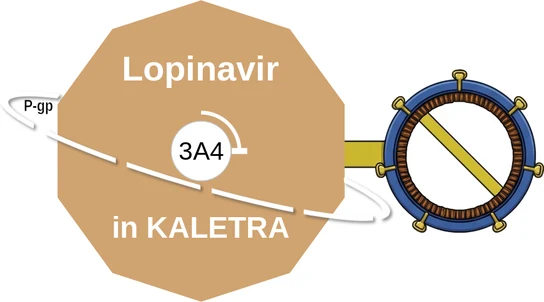
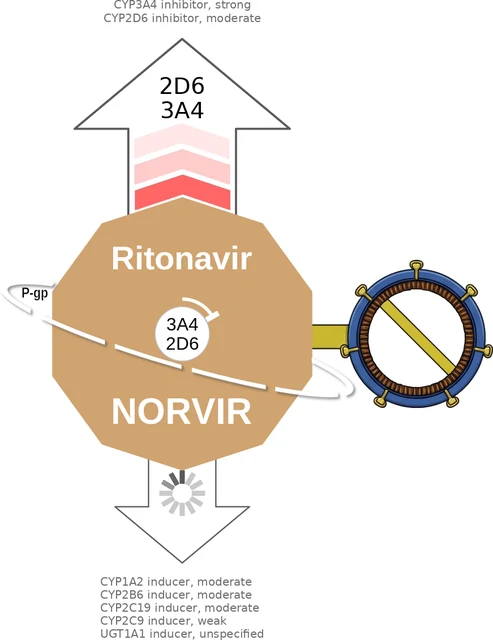
Combination of Lopinavir and Ritonavir.
Each component keeps its own pharmacology page; the combination itself adds no new mechanism.
Components (2)
FDA label
Read the full label on DailyMed ↗
| FDA dosing | Population | Start | Target | Max |
|---|---|---|---|---|
| HIV-1 infection (in combination with other antiretroviral agents) | Adults | 400/100 mg BID or 800/200 mg QD | 400/100 mg BID (or 800/200 mg QD) | 800/200 mg per day |
| HIV-1 infection (in combination with other antiretroviral agents) | Pediatric 14 days to <18 yr | Weight/BSA-based BID (e.g., 230/57.5 mg/m2 BID) | Weight/BSA-based BID | 400/100 mg (5 mL) BID |
| HIV-1 infection (pregnancy, no documented lopinavir-associated resistance) | Pregnant patients | 400/100 mg BID | 400/100 mg BID |
Renal Undefined (not addressed in labeling)
Hepatic Use with caution (principally metabolized by liver; lopinavir concentrations may be increased)
Once-daily dosing not recommended in pediatric patients, in pregnancy, with certain resistance substitutions, or with efavirenz/nevirapine/nelfinavir/carbamazepine/phenobarbital/phenytoin
Instructions
- Tablets: take with or without food; swallow whole, do not chew/break/crush
- Oral solution: must be taken with food; contains ethanol and propylene glycol
- Oral solution not recommended with polyurethane feeding tubes (silicone or PVC can be used)
- Oral solution should not be given to neonates before postmenstrual age 42 weeks and postnatal age of at least 14 days
Available strengths
- tab 100/25, 200/50 mg
- sol 80/20 mg/mL
Contraindications
- Co-administration with drugs highly dependent on CYP3A for clearance and for which elevated plasma concentrations are associated with serious and/or life-threatening reactions (e.g., alfuzosin, ranolazine, dronedarone, colchicine [in renal/hepatic impairment], lurasidone, pimozide, ergot derivatives, cisapride, elbasvir/grazoprevir, lovastatin, simvastatin, lomitapide, suzetrigine, sildenafil [Revatio for PAH], triazolam, orally administered midazolam)
- Co-administration with potent CYP3A inducers where significantly reduced lopinavir plasma concentrations may cause loss of virologic response and possible resistance (e.g., apalutamide, rifampin, St. John's Wort)
Cautions
- Serious adverse reactions due to drug interactions (CYP3A)
- Toxicity in preterm neonates from oral solution excipients (ethanol, propylene glycol)
- Pancreatitis (fatalities have occurred)
- Hepatotoxicity (fatalities have occurred)
- QT interval prolongation and torsade de pointes
- PR interval prolongation / heart block
- New onset or exacerbation of diabetes mellitus/hyperglycemia
- Immune reconstitution syndrome
- Total cholesterol and triglyceride elevations
- Increased bleeding in patients with hemophilia
Adverse reactions
- Diarrhea
- Nausea
- Vomiting
- Hypertriglyceridemia
- Hypercholesterolemia
Pregnancy APR data show no difference in overall major birth defects vs background rate. Administer 400/100 mg BID; once-daily not recommended; avoid oral solution in pregnancy due to ethanol content.
Lactation Instruct mothers not to breastfeed if receiving KALETRA (HIV transmission risk, viral resistance, adverse reactions).
Cost
| Strength | #/mo | generic $ | CostPlus | |
|---|---|---|---|---|
| 100/25 mg | tab | 60 BID | offered | |
| 200/50 mg | tab | 60 BID | $267.89/mo | offered |
| 80/20 mg/mL | sol | per unit | offered |
Other forms: Lopinavir (in KALETRA)
Clinical profile
Defining liabilitySevere drug interactions, pancreatitis and metabolic/hepatic toxicity
Self-check
- Which drugs make up KALETRA?
Lopinavir and ritonavir. - Is KALETRA’s HIV-1 indication used with other antiretrovirals?
Yes.